
AI Overview:
Achieving “five nines” uptime—99.999% availability—demands precision, visibility, and proactive control across every component of your data center network. This 2025 guide by Concertium explains how environmental, power, hardware, and security monitoring come together to ensure reliability, performance, and resilience.
How to Monitor and Manage Your Data Center Network: Ultimate 2025
The Path to “Five Nines” Uptime
Learning how to monitor and manage your data center network is the first step toward achieving 99.999% uptime, or “five nines.” This goal requires a methodical approach to tracking every critical component in your infrastructure, not just hope.
Quick Answer: Essential Steps to Monitor and Manage Your Data Center Network
- Environmental Monitoring – Track temperature (64-81°F), humidity (20-80%), airflow, and water leaks.
- Power Management – Monitor UPS systems, PDUs, and power quality continuously.
- Hardware Surveillance – Watch server CPU/memory, storage capacity, and network device health.
- Security Oversight – Implement physical access controls and cybersecurity monitoring.
- Centralized Tools – Use DCIM software for unified visibility and automated alerts.
- Proactive Analysis – Set thresholds, analyze trends, and plan capacity ahead of needs.
As one expert notes, “Managing a network without monitoring key metrics is like driving a car blindfolded.” With downtime costs reaching thousands per minute, comprehensive monitoring is essential for business survival.
Modern data centers are complex ecosystems where IT, cooling, power, and security must work in harmony. As businesses rely more on digital operations, even brief outages can damage revenue and customer trust. Fortunately, today’s tools provide complete visibility to spot problems before they become disasters.
This guide covers the four pillars of data center monitoring, showing you how to implement a strategy that protects your business while optimizing performance and costs.
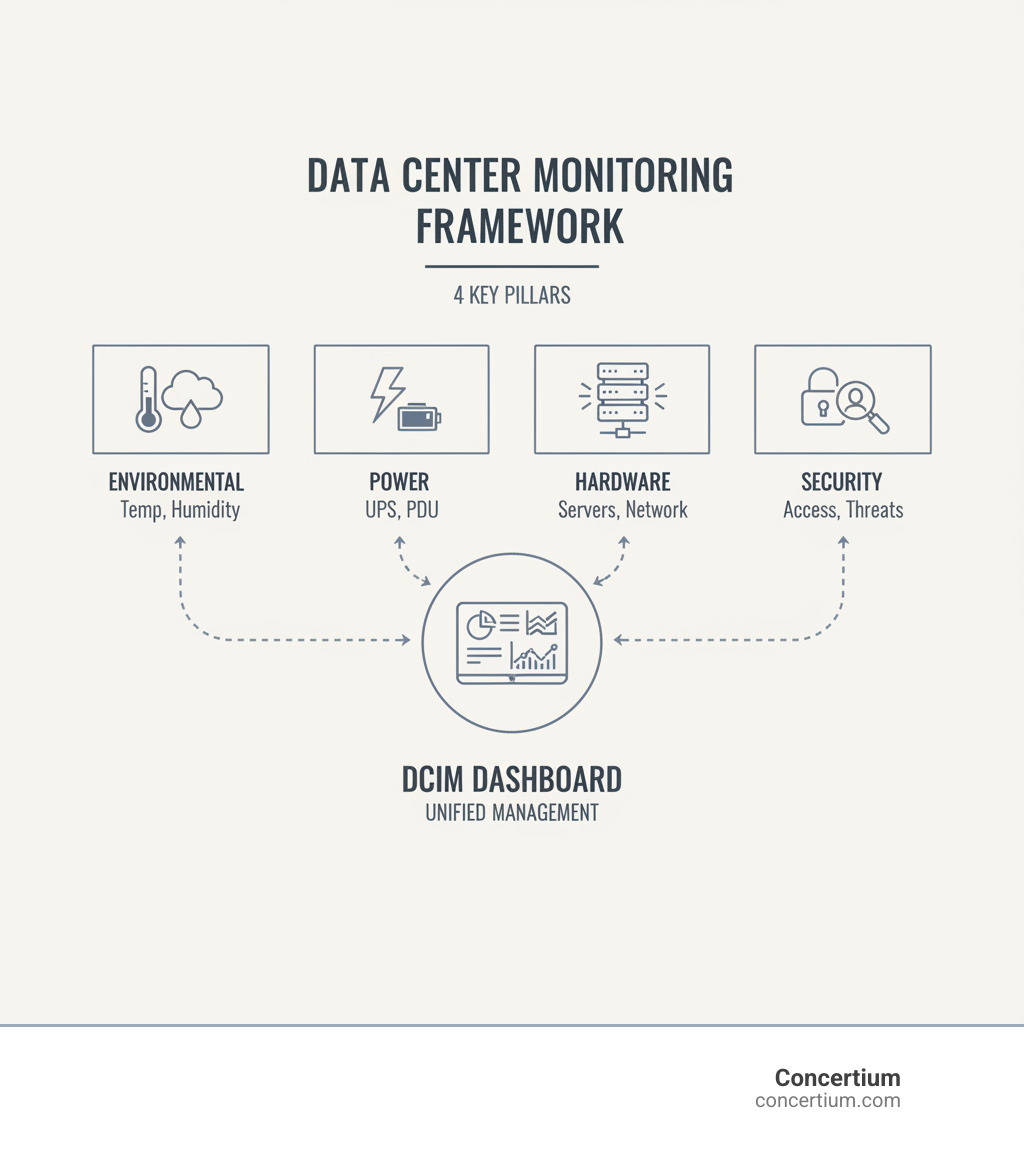
Simple guide to how to monitor and manage your data center network:
Why Data Center Network Monitoring is Non-Negotiable
Thinking about how to monitor and manage your data center network is like maintaining a high-performance race car—you wouldn’t push it to its limits without checking the engine. The primary goal is to ensure continuous availability, optimal performance, and rock-solid security. It’s about creating a proactive shield that catches problems before they become expensive disasters.
A robust monitoring strategy helps you achieve several critical business objectives. Uptime and reliability become a competitive advantage, as vigilant monitoring spots a failing hard drive or overheating server before it causes an outage. This proactive approach is how you achieve the coveted “five nines” of availability.
Performance optimization is a natural result of good monitoring. By identifying bottlenecks like a saturated network link or an overworked server, you can fine-tune systems for peak efficiency. At the same time, monitoring delivers significant cost reduction. It helps eliminate energy waste by identifying “zombie servers” and prevents catastrophic failures that are far more expensive than preventive maintenance.
Monitoring also enables strategic capacity planning. Real-time data and historical trends help you forecast future needs without guesswork, so you know when to add capacity. Finally, security and compliance are essential in today’s threat landscape. Continuous surveillance helps detect unauthorized access, suspicious network traffic, and ensures you meet regulatory requirements. This aligns with comprehensive Compliance and Risk Management strategies and robust Cybersecurity Risk Management Frameworks.
In short, a well-designed monitoring strategy transforms your operations by:
- Preventing downtime: Early warnings from intelligent alert thresholds let your team address rising server temperatures or filling storage arrays before they cause an outage.
- Improving productivity: A unified dashboard provides centralized visibility, eliminating guesswork and reducing time spent troubleshooting.
- Reducing operational risk: Comprehensive monitoring improves your security posture and compliance stance, reducing the likelihood of data breaches or system failures. It’s a key part of effective Vulnerability Risk Management.
- Enabling data-driven decisions: Raw metrics become actionable insights that guide infrastructure investments and operational improvements.
- Improving scalability: Real-time visibility into resource utilization helps you identify stranded capacity and forecast when new resources are needed, ensuring efficient growth.
This comprehensive approach integrates seamlessly with broader Managed IT Services strategies, ensuring your data center operates at peak efficiency while minimizing operational expenses.
The Four Pillars of Comprehensive Data Center Monitoring
To effectively monitor and manage your data center network, you must adopt a holistic mindset. Effective monitoring extends beyond IT equipment to encompass your entire facility infrastructure, which rests on four essential pillars.
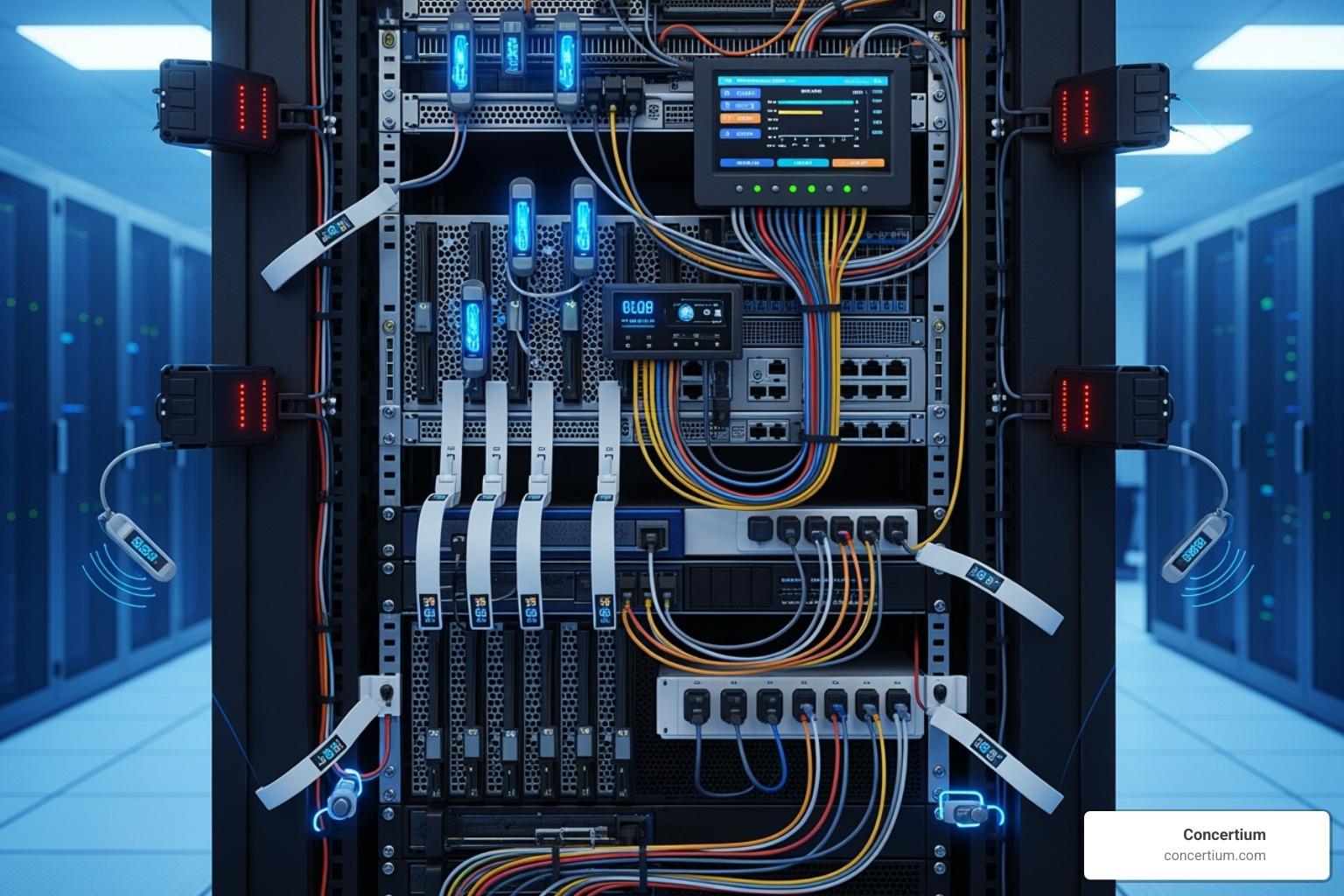
Environmental Monitoring: Maintaining a Healthy Habitat
Your hardware requires a stable environment to perform optimally. Environmental monitoring is your insurance against conditions that can cause system failures.
- Temperature Monitoring: The American Society of Heating, Refrigerating and Air-Conditioning Engineers (ASHRAE) recommends keeping hardware between 64°F and 81°F (18°C to 27°C). Use sensors in cold and hot aisles and near AC units to create a thermal map and identify hotspots.
- Humidity Control: High humidity (>90%) causes condensation and corrosion, while low humidity (<10%) creates a risk of static discharge. ASHRAE suggests a range of 20% to 80%, with 60% being ideal.
- Airflow Management: Monitor air volume and velocity to ensure cool air reaches equipment and hot air is exhausted efficiently. Poor airflow can create hotspots even if the overall room temperature is normal.
- Water and Smoke Detection: Place moisture sensors under raised floors and pipes to detect leaks early. Optical or ionization smoke detectors provide critical warnings before a fire can spread.
For businesses in challenging climates, local expertise is invaluable. Our IT Support Tampa Top 5 Outstanding Services 2025 ensures your environmental controls are optimized.
Power Monitoring: Keeping the Lights On
Clean, consistent power is the lifeblood of your data center. Power monitoring ensures it never stops flowing.
- Uninterruptible Power Supply (UPS): Monitor battery health, load capacity, and runtime estimates to ensure your first line of defense is ready for an outage.
- Power Distribution Units (PDUs): Modern PDUs offer outlet-level monitoring, revealing how much power each device consumes. This helps balance loads and prevent overloads.
- Power Quality Monitoring: Analyze voltage stability, frequency, and harmonics to protect equipment from damage caused by poor power quality.
- Redundancy Checks: Regularly verify that backup power paths are functional and ready to take over instantly if a primary path fails.
Managing this complex electrical ecosystem is a core component of our Managed IT Services in Tampa.
Key Aspects of Hardware Monitoring for Your Data Center Network
Your IT hardware transforms power and cooling into digital services. Monitoring these workhorses ensures they stay healthy and productive.
- Server Monitoring: Track vital signs like CPU load, memory usage, disk I/O, and network interface utilization. Watching trends helps you spot performance degradation before it leads to failure.
- Storage Systems: Monitor capacity utilization to prevent running out of space, and track I/O performance (read/write speeds, latency) to ensure smooth data flow. Health monitoring can predict disk failures.
- Network Equipment: For switches, routers, and firewalls, monitor port utilization, packet error rates, and latency/throughput. This reveals traffic patterns and potential congestion points.
Effective network monitoring is critical for security. Our Managed Network and Firewalls services keep your infrastructure fast and secure.
Essential Security Monitoring for Your Data Center Network
Security monitoring creates layered protection for your physical and digital assets.
- Physical Security: Use access control systems (RFID, biometrics) to log entry, surveillance cameras to monitor sensitive areas, and contact closure sensors on cabinets to alert you to unauthorized access.
- Cybersecurity Monitoring: Regularly perform vulnerability scanning to find weaknesses before attackers do, a core part of our Cybersecurity Risk Assessment Services.
- Threat Detection: Implement Intrusion Detection and Prevention Systems (IDPS) to analyze network traffic and block malicious activity. Continuous network traffic analysis is essential for Network Threat Detection and is a key feature of our Threat Detection and Response Services. For stealthy attackers, our Advanced Persistent Threats Monitoring Services provide deep visibility.
How to Monitor and Manage Your Data Center Network: Tools and Systems
To successfully monitor and manage your data center network, you need the right tools working in harmony. Centralized management, automation, and real-time data collection are key to turning chaos into a well-conducted orchestra.
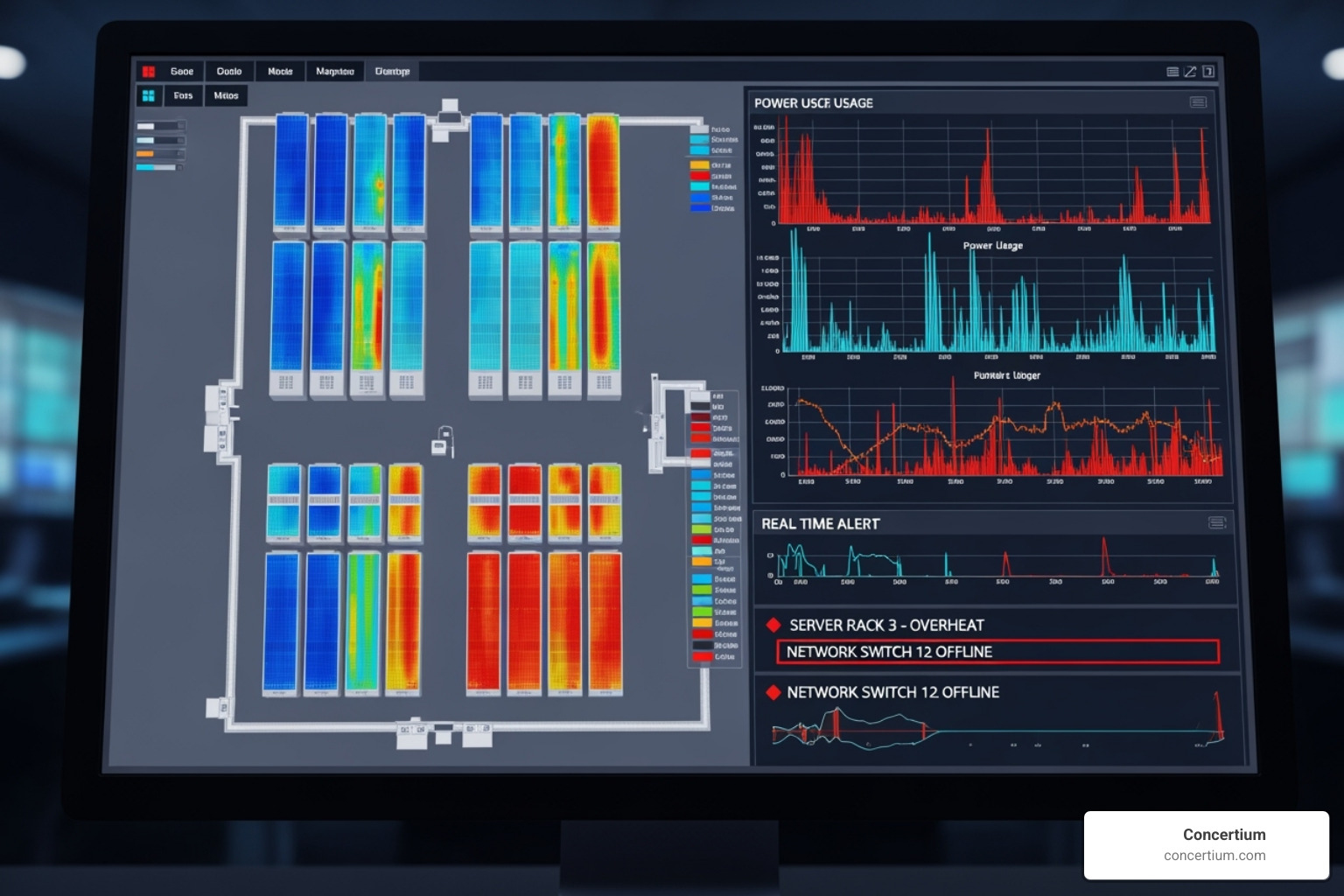
The Role of DCIM Software
Data Center Infrastructure Management (DCIM) software is the central nervous system of your operation, preventing you from managing a complex facility with spreadsheets. It acts as a mission control center, tracking and managing every component.
DCIM provides a real-time inventory for asset management, transforms capacity planning from guesswork into science by visualizing resource usage, and offers real-time visualization through interactive dashboards. Its reporting and analytics capabilities turn raw data into business intelligence, helping you make informed decisions. This intelligence is a crucial data source for our Enterprise Cybersecurity Solutions strategy.
Key Monitoring Protocols and Tool Categories
Monitoring systems rely on communication protocols to gather data. Understanding these helps you choose the right tools.
- SNMP (Simple Network Management Protocol): The workhorse for monitoring network devices like routers, switches, and servers.
- Modbus: The preferred protocol for industrial control systems, used for monitoring power infrastructure like PDUs and UPS systems.
- HTTPS: Handles secure communication with web-based management interfaces and APIs.
Powerful open-source tools are also available:
- DCIM & Asset Management: OpenDCIM and RackTables help track components, while NetBox focuses on network architecture management.
- Network Scanning: Nmap finds resources on your network.
- Bare-Metal Provisioning: Tinkerbell automates server deployment.
- Performance Monitoring & Visualization: Prometheus collects metrics, Grafana creates dashboards, and Zabbix offers comprehensive monitoring and alerting.
These tools are foundational to effective network management and integrate seamlessly with our IT Security Managed Services to ensure secure, efficient operations.
From Data to Decisions: Activating Your Monitoring Strategy
Collecting data is useless if it isn’t turned into actionable insights. Your monitoring data is a constant conversation, telling you about performance trends, potential problems, and opportunities for improvement. The key is to listen and respond.
This approach enables proactive maintenance, allowing you to fix issues during business hours instead of reacting to a 2 AM crash. Predictive analysis takes this further, using historical patterns to forecast when equipment might fail. This data-driven insight allows for surgical resource allocation, helping you redistribute workloads and make smarter purchasing decisions. Your monitoring strategy becomes a source of business intelligence, guiding growth and efficiency. This is especially valuable for informing Cybersecurity Threats for Business Intelligence, where data-driven security is critical.
Using Monitoring for Capacity Planning and Scalability
Your monitoring data is a roadmap to the future, showing you where you are and where you’re headed.
- Forecast Future Needs: Analyze historical usage trends to accurately predict when you’ll need more server, storage, or network capacity.
- Identify Stranded Capacity: Find and use resources that are available but unused due to issues like poor cooling or lack of network connectivity.
- Optimize Space, Power, and Cooling: Use performance data to improve rack layouts, identify hotspots, and predict how new equipment will impact power and cooling infrastructure.
- Right-Size Infrastructure: Stop over-provisioning equipment “just in case.” Invest in exactly what you need, when you need it. This approach is central to scalable Managed Cybersecurity Services.
Ensuring Uptime and Reliability Through Proactive Management
Proactive management is about preventing fires, not just fighting them. An effective strategy to monitor and manage your data center network spots problems before they become disasters.
- Set Smart Alert Thresholds: Configure alerts to catch meaningful deviations from normal behavior without creating “alert fatigue” from false alarms.
- Use Automated Responses: Automate routine fixes, like restarting a non-critical service when memory usage is high, to buy time for root cause analysis.
- Perform Root Cause Analysis: Use comprehensive monitoring data to trace failures back to their source and implement permanent fixes.
- Leverage Predictive Failure Analysis: Analyze subtle changes in performance metrics to predict hardware failures weeks or months in advance, allowing for strategic maintenance.
This proactive approach minimizes downtime and maintains the robust security posture central to our Advanced Threat Protection services.
Frequently Asked Questions about Data Center Network Management
When learning how to monitor and manage your data center network, a few key questions often arise. Here are straightforward answers to the most common concerns.
What is the primary goal of data center monitoring?
The primary goal is to ensure your data center runs smoothly, performs optimally, and remains secure. It's about being proactive rather than reactive, identifying potential issues like rising temperatures or suspicious network activity before they escalate into costly downtime. This approach improves reliability, efficiency, and business continuity.
What's the difference between data center monitoring and DCIM?
Think of it this way: data center monitoring is the collection of data, while DCIM is the brain that analyzes it. Monitoring involves the sensors and tools that gather health and status information from your infrastructure. Data Center Infrastructure Management (DCIM) is the software that centralizes this data, providing a holistic view to help you manage, analyze, and plan your entire facility, from servers and storage to power and cooling.
What are the most critical metrics to monitor in a data center?
Critical metrics fall into four key categories: Environmental: Rack temperature (target 64-81°F), humidity (target 20-80%), airflow, and alerts for water leaks or smoke.
Power: Uninterruptible Power Supply (UPS) battery health and load, Power Distribution Unit (PDU) outlet-level draw, and overall Power Usage Effectiveness (PUE).
Hardware: Server CPU and memory utilization, storage capacity and I/O performance, and network device metrics like latency, throughput, and error rates.
Security: Physical access logs and continuous network traffic analysis to detect anomalies and potential cyber threats.
Conclusion: Achieve Total Network Visibility and Control
Understanding how to monitor and manage your data center network is essential for business survival in a world that depends on being online. A comprehensive plan that integrates environmental, power, hardware, and security monitoring creates a protective shield around your critical assets, preventing most outages before they happen.
The best monitoring strategies turn data into smart decisions, helping you optimize costs, ensure uptime, and protect your infrastructure. It’s about moving from reactive firefighting to proactive management, where you can spot a failing component or a cooling issue long before it becomes a disaster.
At Concertium, we help organizations achieve this total network visibility. Our data-driven approach and seamless security integration transform operations. Your data center is the heartbeat of your business; let us help you protect it. For organizations ready to fortify their infrastructure, Concertium provides expert Cybersecurity Services Tampa to secure your systems from the inside out.
Ready to achieve bulletproof reliability? Explore our network monitoring and management services and see how proper monitoring can become your competitive advantage.