
Advanced network security monitoring brings together continuous traffic capture, endpoint telemetry, and contextual security signals with analytics that turn raw data into prioritized, action-ready detection and response. With AI-enhanced observability, teams reduce detection latency and dwell time so they can contain threats sooner and limit business impact. This guide describes how advanced monitoring works, how AI and behavioral analytics sharpen detection and prioritization, and which managed services and proactive defenses deliver measurable risk reduction.
You’ll get practical guidance on managed SOCs, managed firewall and IDS/IPS practices, vulnerability management, and Zero Trust approaches, plus how incident response and compliance advisory support recovery and regulatory obligations. We reference SIEM, SOAR, UEBA, MDR, and network traffic analysis to connect capabilities to outcomes for both technical and executive decision-making.
What is Advanced Network Security Monitoring and Why is it Essential?
Advanced network security monitoring is the ongoing collection and analysis of network and entity telemetry to detect, prioritize, and enable rapid response to threats. It aggregates packets, logs, flow data, and endpoint signals into correlation engines where analytics and threat intelligence reveal patterns and anomalies that indicate compromise. The clear benefit is earlier detection and prioritized alerts that reduce dwell time and enable targeted containment—directly lowering potential breach costs and operational disruption. Organizations that move from periodic or rule-only monitoring to entity-rich observability can surface lateral movement, data exfiltration, and stealthy credential abuse sooner, improving security posture and business resilience. That capability is the basis for threat detection workflows that protect critical assets and limit attack impact.

How Does Network Threat Detection Protect Your Business?
Network threat detection identifies malicious activity across the attack lifecycle—initial access, lateral movement, and exfiltration—and triggers alerts and containment workflows. Detection combines signature-based indicators, anomaly-detection models, and threat-intel correlation to spot known malware, novel command-and-control patterns, and suspicious lateral behavior. For example, a workflow may flag an unusual surge of data from a sensitive server, enrich the alert with user context, and escalate to containment actions like isolating the host or blocking the session. These processes shorten mean time to detection and let responders contain threats before they spread, preserving data integrity and operational continuity.
What Are the Key Components of Effective Network Protection?
Effective network protection depends on a coordinated stack of sensors, analytics, and preventive controls that detect and stop threats together. Core elements include distributed network sensors and probes for traffic capture, log aggregation into SIEM systems, automated playbooks run by SOAR platforms, and preventive controls such as managed firewalls and IDS/IPS. These pieces interoperate: sensors feed SIEM correlation, SIEM triggers SOAR workflows for triage and containment, and preventive controls enforce policies and segmentation informed by analytics. That layered approach delivers both visibility and the ability to act—essential for maintaining business continuity and minimizing breach impact.
In practice, continuous observability shifts teams from firefighting to prioritized response.
- Advanced monitoring shortens detection time across the kill chain.
- Correlated analytics reduce false positives and focus analyst effort.
- Preventive controls enforce least privilege and limit lateral spread.
Together, these capabilities enable faster containment and smoother incident response.
How Does AI-Enhanced Advanced Observability Transform Network Security?
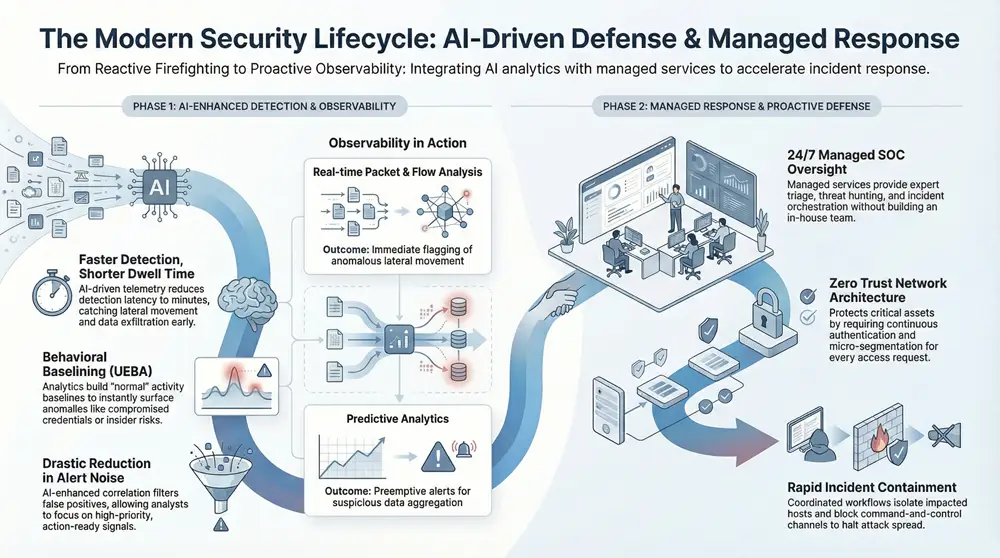
AI-enhanced observability extends traditional monitoring by applying machine learning to streaming telemetry for anomaly detection, behavioral baselining, and predictive modeling. Both unsupervised and supervised models identify statistical deviations, correlate dispersed signals, and prioritize incidents with contextual risk scoring. The immediate gains are higher detection fidelity, lower alert noise, and faster analyst time-to-value—improving SOC efficiency and accelerating containment. Recent deployments show AI-driven observability supports scalable threat hunting and predictive alerts that catch subtle indicators—like credential misuse or data staging—before large-scale exfiltration. That sets the stage for the technical roles AI plays in real-time detection and how UEBA improves outcomes.
Consider how observability features map to detection outcomes and business value.
This comparison links observability components to measurable outcomes that reduce incident impact and streamline response.
What Role Does AI Play in Real-Time Threat Detection and Anomaly Analysis?
AI models process high-volume telemetry to surface deviations that static rules miss, using unsupervised learning for novel anomalies and supervised classifiers for known threat patterns. Common model types include clustering for behavioral baselines, isolation forests for outlier detection, and gradient-boosted classifiers that fuse network, endpoint, and identity signals. Streaming analytics apply these models to session- and flow-level data, producing scored alerts that feed orchestration layers for automated containment. By reducing noise and elevating high-confidence incidents, AI lets analysts focus on real risk and speeds escalation for incidents threatening critical assets.
Those model-based detections highlight the value of behavior-oriented analytics next.
How Does User Behavior Analytics Improve Cybersecurity Outcomes?
User and entity behavior analytics (UEBA) build baselines for normal actions, then surface deviations—unusual logins, abnormal data access, or atypical process activity—that indicate account compromise or insider risk. UEBA combines identity context, device posture, and access patterns to assign anomaly scores that feed SIEM correlation and SOAR playbooks for automated investigation. For example, an employee accessing large volumes of sensitive files at odd hours can trigger temporary access restrictions while the event is investigated. Integrating UEBA with response tools shortens dwell time, reduces privileged-abuse risk, and lowers false-positive workloads for SOC analysts.
AI-enabled observability naturally leads into managed SOC delivery models that operationalize these capabilities at scale.
What Are Managed Security Operations Center Services and Their Benefits?
Managed Security Operations Center (SOC) services deliver external 24/7 monitoring, alert triage, and incident orchestration so organizations can access advanced detection and remediation without building a full in-house team. These services combine continuous monitoring, SIEM/SOAR management, threat hunting, and managed firewall and IDS/IPS oversight to provide consistent detection and rapid escalation. The business benefits include predictable SLAs, access to specialized analyst expertise, and scalable coverage that adapts to changing threats. Outsourcing to a managed SOC reduces recruiting and training overhead while ensuring critical alerts receive timely human investigation and response.

Below is a structured comparison of common SOC service elements and their business impact.
This table clarifies what managed SOCs deliver and how those elements translate into business resilience and operational efficiency.
How Does 24/7 SOC Monitoring Enhance Network Threat Detection?
Around-the-clock SOC monitoring shrinks detection windows by keeping telemetry and alerts under continuous review, so suspicious activity outside business hours is identified and escalated. Analysts follow triage playbooks to validate signals, enrich incidents with context, and initiate containment or escalate to incident response teams. Typical SLAs define detection and response timeframes that accelerate isolation of compromised hosts and segments. Continuous monitoring also enables ongoing threat hunting that uncovers latent threats and reduces the risk of prolonged, unnoticed compromise.
What Managed Firewall and Intrusion Detection Solutions Are Included?
Managed firewall and IDS/IPS services cover policy creation, rule tuning, signature updates, and configuration hardening to protect perimeter and internal controls. Core tasks include policy reviews, change management for allowed services, and adaptive tuning to reduce false positives while retaining detection fidelity. Vendors’ technologies operate as rule engines, stateful inspection, and anomaly-based detection that SOC teams monitor and refine over time. Regular configuration reviews and automated monitoring prevent policy drift and keep firewalls and IDS/IPS aligned with evolving threat models.
These managed capabilities make outsourced SOCs a practical, expert-led option for sustained network protection.
How Does Cybersecurity Incident Response Minimize Damage from Attacks?
Incident response follows a lifecycle—detect, contain, eradicate, recover, and learn—that minimizes disruption and preserves evidence for forensics and compliance. Rapid triage establishes scope and severity, containment isolates affected systems to stop lateral movement, eradication removes malicious artifacts, and recovery restores services while validating remediation. A structured response shortens downtime, limits data exposure, and produces remediation plans and compliance documentation for regulators or stakeholders. Understanding containment and eradication tactics is essential for executing these lifecycle stages effectively.
What Are the Steps in Effective Incident Containment and Eradication?
Containment starts with segmenting the network, isolating impacted hosts, and blocking command-and-control channels to halt ongoing activity. Eradication follows: remove malware, close exploited vulnerabilities, and restore systems from known-good images or backups while validating integrity. Coordination with IT, legal, and business owners ensures containment balances security and operational needs. Validation includes forensic scans, patch verification, and monitoring for recurrence to confirm eradication before systems return to normal.
After containment and eradication, teams shift to post-breach management, forensics, and compliance reporting to close the incident lifecycle.
How Does Post-Breach Management Support Recovery and Compliance?
Post-breach management includes digital forensics to preserve and analyze evidence, remediation validation to confirm systems are clean, and advisory support for regulatory notifications and reporting. Forensics teams collect logs, image disks, and document timelines to support root-cause analysis and regulatory submissions. Remediation validation uses re-scans, integrity checks, and controlled restores to show systems are secure before reactivation. Legal and compliance guidance shapes notification timelines and report contents to meet obligations and limit downstream liability.
Concertium’s Post-Breach Management combines incident response and digital forensics in a coordinated recovery approach, helping organizations stabilize environments and meet compliance requirements quickly. For emergency consultation, Concertium provides structured post-breach services that pair investigative rigor with practical remediation guidance.
What Proactive Network Defense Strategies Strengthen Your Security Posture?
Proactive defenses shrink the attack surface and increase the cost of compromise through continuous vulnerability management, penetration testing, micro-segmentation, and Zero Trust Network Architecture. These strategies find misconfigurations, validate detection and response controls, and enforce least-privilege access to limit lateral movement. A regular cadence of scans, prioritized remediation, and validation testing keeps defenses aligned to new vulnerabilities and business change. Implementing these measures reduces common exploitation paths and improves incident readiness.
This table helps decision-makers compare proactive strategies, recommended cadence, and typical remediation actions.
How Do Vulnerability Management and Penetration Testing Identify Risks?
Vulnerability management (VM) uses automated scanners to detect known CVEs and misconfigurations, while penetration testing simulates attacker behavior to validate exploitability and business impact. VM gives broad coverage and prioritization metrics such as CVSS, whereas pen testing demonstrates end-to-end attack paths and contextual business risk. Typical workflows prioritize high-severity issues that affect critical assets, apply remediation, and re-scan to verify closure. Combining VM with periodic pen testing ensures technical fixes translate into lower real-world risk.
These detection and validation practices underpin Zero Trust, which tightens access and reduces exposure.
What Is Zero Trust Network Architecture and How Does It Protect Networks?
Zero Trust Network Architecture follows “never trust, always verify” by requiring continuous authentication, strict access controls, and micro-segmentation to prevent lateral movement. Implementation steps include identifying critical assets, segmenting network zones, applying identity-based access policies, and instrumenting continuous monitoring for every access transaction. Treating each access as potentially hostile and enforcing least privilege reduces breach blast radius and forces attackers to overcome multiple controls. Phased adoption—starting with critical workloads and expanding—delivers immediate risk reduction while enabling progressive maturity.
A practical checklist for Zero Trust adoption:
- Identify sensitive assets and map existing access paths.
- Apply micro-segmentation to separate workloads by trust level.
- Enforce strong identity and device posture checks on every request.
- Monitor and continuously validate policy efficacy through telemetry.
These steps help make Zero Trust an operational component of a proactive defense strategy.
How Do Compliance and Risk Advisory Services Support Network Security?
Compliance and risk advisory services connect technical controls to regulatory requirements, perform gap analyses against frameworks, and create policies that operationalize security objectives. Advisors map controls—encryption, logging, access control—to specific frameworks and produce remediation roadmaps that balance security, compliance, and business priorities. Risk assessments quantify likelihood and business impact, enabling prioritized investment in defenses that reduce technical and regulatory exposure. The sections that follow explain which frameworks matter for networks and how policy development reduces cyber risk.
Which Regulatory Frameworks Impact Network Security Compliance?
Multiple regulatory frameworks require network-related controls—encryption, logging, access controls, and incident reporting—across industries. Typical frameworks cover payment card data, healthcare records, government contracting, and privacy regulations, each mandating specific safeguards. Organizations map controls to frameworks by identifying applicable requirements, documenting evidence, and implementing technical controls that satisfy audits. Clear mappings let security teams design controls that meet compliance while strengthening underlying security.
Translating framework requirements into concrete controls makes policy development actionable and audit-ready.
How Does Security Policy Development Mitigate Cyber Risks?
Security policy development creates repeatable rules—access, incident response, acceptable use—that define expected behavior and enforcement across the network. The lifecycle includes drafting, stakeholder review, technical implementation, compliance monitoring, and periodic review. Policies mitigate risk by codifying controls and defining enforcement, such as segmentation, privileged access reviews, and logging standards. A short lifecycle checklist: inventory assets, define control objectives, implement controls, and schedule regular reviews to keep policies aligned with business changes.
- Concertium provides Compliance and Risk Advisory as part of its services, helping map network controls to regulatory frameworks and implement remediation roadmaps.
- Our advisory work focuses on translating technical controls into audit artifacts and operational procedures.
- For organizations seeking structured, compliance-driven security improvements, Concertium’s advisory offerings combine technical and regulatory expertise.
- Prioritize: Focus on controls that protect critical assets and meet core regulatory obligations.
- Implement: Turn policy into technical enforcement through segmentation, logging, and access controls.
- Validate: Use scans, audits, and testing to confirm controls work as intended.
These steps ensure compliance work strengthens—rather than distracts from—core security objectives.
Frequently Asked Questions
Conclusion
Advanced network security monitoring, powered by AI-driven observability and layered defenses, meaningfully improves detection and response. Continuous telemetry, proactive defenses, and managed services combine to preserve operations and limit breach impact while supporting compliance. If you want to strengthen detection, reduce risk, and speed recovery, our tailored cybersecurity services are designed to meet those goals—reach out to learn how we can help elevate your defenses.