Data security compliance has emerged as a pivotal cornerstone for organizations across the globe. This concept encapsulates the adherence to legal, regulatory, and technical standards designed to protect sensitive information from unauthorized access, use, or data breaches. Data security compliance serves not only as a shield for personal data but also as safeguarding the integrity...
Data security compliance has emerged as a pivotal cornerstone for organizations across the globe. This concept encapsulates the adherence to legal, regulatory, and technical standards designed to protect sensitive information from unauthorized access, use, or data breaches.
Data security compliance serves not only as a shield for personal data but also as safeguarding the integrity and confidentiality of an organization’s information assets. Therefore, understanding and implementing robust data security measures is indispensable.
In this blog post you’ll learn about data security compliance, challenges and its impact on businesses.
What is Data Security Compliance
At its core, data security compliance refers to policies, procedures, and security standards that ensure data protection. This encompasses a broad spectrum of sensitive data types, including but not limited to Personally Identifiable Information (PII), financial information, and Protected Health Information (PHI) as outlined by CompTIA. For instance, PII can range from basic contact information to more sensitive details such as social security numbers and medical records.
Safeguarding this data not only protects individuals’ privacy but also shields organizations from potential threats and vulnerabilities. In other words, compliance is not merely a legal obligation but a critical component of an effective information security management strategy.
In addition, compliance with standards such as the General Data Protection Regulation (GDPR), the Payment Card Industry Data Security Standard (PCI DSS), and the Health Insurance Portability and Accountability Act (HIPAA) serves as a testament to an organization’s commitment to security and privacy. These compliance standards are essential in preventing data breaches, ensuring data privacy, and fostering trust among consumers and partners alike.
Above all, navigating the complex terrain of data security compliance requires a comprehensive understanding of the applicable regulations and the implementation of rigorous security measures. After that, organizations must also continuously monitor and update their compliance practices to align with emerging security standards and technologies.
Major Data Security Regulations and Standards
Data security compliance requires a deep understanding of various regulations and standards. These frameworks are pivotal in ensuring the protection of sensitive data across different sectors. Let’s delve into some of the most critical ones.
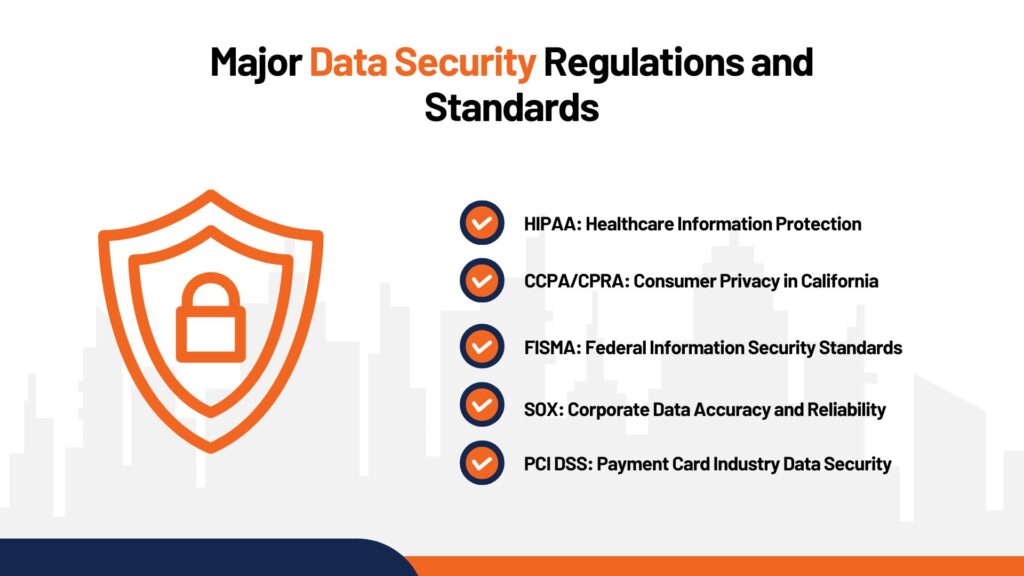
HIPAA: Healthcare Information Protection
The Health Insurance Portability and Accountability Act (HIPAA) is a important in the healthcare industry. It mandates the safeguarding of health information to protect patient privacy. Healthcare providers, insurers, and their business associates must ensure that personal health data is kept confidential and secure, both in digital and non-digital forms.
This includes implementing security controls to guard against unauthorized access and ensuring data integrity. The significance of HIPAA lies in its comprehensive approach to data protection compliance, covering aspects from data storage to data transfer.
CCPA/CPRA: Consumer Privacy in California
California has set a benchmark for data privacy with the California Consumer Privacy Act (CCPA) and the California Privacy Rights Act (CPRA). These laws give residents more control over their personal information. Businesses that collect, store, or utilize California residents’ data must comply with these regulations.
They emphasize the right to know what data is collected, the purpose of its use, and the right to have it deleted. These acts underscore the importance of transparency and customer data protection, influencing data governance models beyond California’s borders.
FISMA: Federal Information Security Standards
The Federal Information Security Management Act (FISMA) applies to federal agencies and entities dealing with government data. It requires the implementation of information security management systems to protect data integrity, confidentiality, and availability.
FISMA’s framework includes risk assessments, security policies, and compliance audits to ensure robust data security and compliance within government operations. By setting a high standard for data management, FISMA plays a crucial role in national security and governance.
SOX: Corporate Data Accuracy and Reliability
The Sarbanes-Oxley Act (SOX) focuses on corporate governance and financial practices, particularly for publicly traded companies. It mandates strict record-keeping and data management practices to prevent fraud and ensure financial data’s accuracy. SOX has significantly influenced how companies approach data protection compliance and information security, emphasizing the need for transparent and reliable financial reporting.
PCI DSS: Payment Card Industry Data Security
The Payment Card Industry Data Security Standard (PCI DSS) is vital for any business that processes, stores, or transmits cardholder data. Developed by the Payment Card Industry Security Standards Council, this set of security standards is designed to protect payment card information from data breaches and fraud. Compliance with PCI DSS is not optional; it’s a necessity for safeguarding customer data and maintaining trust in the financial transactions ecosystem.
Implementing a Compliance Program
Steps to Start a Cybersecurity Compliance Program
Launching a cybersecurity compliance program is crucial for any organization that aims to protect its data effectively.
According to CompTIA, the first step involves understanding the specific data security and compliance requirements that apply to your industry. This includes familiarizing oneself with relevant standards and regulations.
After that, conducting a risk assessment to identify vulnerabilities in your current system is key.
The next phase involves developing a comprehensive compliance framework that addresses these risks and aligns with industry standards. Essential to this process is the creation of policies that govern how data is handled, protected, and accessed.
Data Classification, Encryption, and User Access Control
Forcepoint emphasizes the importance of data classification in a robust data security compliance program. This process involves categorizing data based on sensitivity and the level of protection it requires. Sensitive data, such as personal information and cardholder data, should be encrypted to prevent unauthorized access.
Additionally, implementing strict user access control measures ensures that only authorized personnel can access certain data, minimizing the risk of data breaches.
Continuous Review and Adjustment of Data Protection Measures
Its necessity for continuous review and adjustment of data protection measures. The data security landscape is ever-changing, with new threats emerging regularly. Therefore, organizations must regularly review their security measures and compliance policies to ensure they remain effective. This includes updating security controls, conducting regular compliance audits, and training staff to recognize and respond to security threats appropriately.
Challenges in Data Security Compliance

Keeping Up with Evolving Standards and Technologies
One of the significant challenges in data security compliance is staying abreast of evolving standards and technologies. Regulations and security requirements are constantly changing, requiring organizations to be vigilant and adaptable. This necessitates a commitment to ongoing education and investment in the latest security technologies to protect customer data effectively and comply with data protection compliance standards.
Balancing Compliance with Operational Efficiency
Experts points out the challenge of balancing compliance with operational efficiency. Implementing comprehensive security and data compliance measures can be resource-intensive and may impact day-to-day operations. Organizations must find a way to integrate compliance requirements seamlessly into their operations without hindering efficiency. This involves leveraging technology to automate compliance processes and designing security controls that support business processes rather than obstruct them.
Implementing a data security compliance program and overcoming its challenges requires a strategic approach that incorporates understanding regulations, classifying data appropriately, and continuously adapting to new threats. Balancing the demands of compliance with operational efficiency remains a complex but essential task for organizations aiming to protect sensitive data and maintain trust with their stakeholders.
How Data Compliance Impacts Businesses
Data compliance transcends mere security measures, embedding deeply into how businesses handle, transmit, and leverage data within their operations. It sits at the crossroads of safeguarding consumer/patient/client data privacy and the legitimate use of such information by businesses. Understanding your organization’s obligations under data compliance involves several critical considerations:
Protection Against Unauthorized Use: Ensuring data is shielded from unauthorized use or disclosure.
Protection Measures: Identifying whether data should be secured through technical, administrative, or physical safeguards.
Usage of Data: Determining how data is utilized, whether for business operations or customer/client/patient services.
Data compliance is pivotal for businesses due to several reasons:
Upholding Individual Rights: Aligns the management of business information with the rights of individuals to control and access their information, with specific regulations varying across industries.
Ethics and Data Privacy: Acts as a cornerstone of ethical standards, particularly in sectors like healthcare, retail, and finance, where user privacy is deemed fundamental.
Business Uses of Data: Governs the appropriate business use of data, including restrictions and guidelines on data utilization, retention, and conditions under which it can be used.
Consent Management: Emphasizes the necessity for clear consent mechanisms, where certain frameworks mandate businesses to secure documented consent for data use in marketing or other purposes.
This multifaceted approach to data compliance not only ensures security but also enforces ethical use, respects individual rights, and mandates clear consent processes, fundamentally shaping how businesses operate and engage with data in the digital age.
Best Practices for Data Security Compliance
To achieve robust data security compliance, adopting best practices is crucial. This includes ongoing employee education and attaining relevant certifications.

Regular Employee Training and Awareness Programs
First and foremost, regular training and awareness programs are vital. Training can equip employees with the knowledge to handle sensitive data securely and understand the potential risks of data breaches. Training programs should not only cover the basics of data security but also keep staff updated on the latest threats and compliance requirements. This ensures that everyone in the organization plays an active role in safeguarding customer data.
Compliance Audits and Certifications
Furthermore, obtaining audits and certifications like ISO 27001, PCI DSS, and GDPR Compliance is essential. These certifications demonstrate an organization’s commitment to data protection compliance. They also provide a framework for managing data security and ensure that companies meet international security and privacy policies. Engaging in regular compliance audits helps identify gaps in data management and security controls, enabling timely adjustments to maintain high security standards.
What People Also Ask
What is Data Security Compliance?
Data security compliance refers to adhering to laws, regulations, and standards designed to protect personal information and sensitive data from unauthorized access and misuse. It's about ensuring that data is used, stored, and managed in a way that meets security requirements and protects the privacy of individuals.
Why is Compliance Important?
Compliance is critical because it helps prevent data misuse and breaches, which can lead to significant financial and reputational damage. It also ensures that an organization respects and protects the personal data of its customers and employees, thereby fostering trust.
How Can Organizations Ensure Compliance?
Organizations can ensure compliance by implementing a robust data security and compliance program that includes data classification, encryption, and user access control. Regular employee training, compliance audits, and obtaining relevant certifications are also key strategies for maintaining data security compliance.
Key Takeaways and Final Considerations
Implementing a robust data security compliance program, staying abreast of evolving standards and technologies, and balancing operational efficiency are critical steps toward safeguarding sensitive data. By investing in regular employee training, achieving compliance certifications, and continuously reviewing security measures, companies can build a strong foundation for data protection.
This approach not only ensures compliance with current regulations but also prepares organizations for future challenges in the digital landscape. Above all, a commitment to data security compliance demonstrates an organization’s dedication to protecting its customers’ data, thereby fostering trust and ensuring long-term success in the ever-evolving world of data security and privacy.
organization, international organization for standardization, regulation, risk, data breach, best practice, risk management, cloud computing, risk assessment, audit, health insurance portability and accountability act, general data protection regulation, regulatory compliance, hitrust, accountability, national institute of standards and technology, policy, automation, certification, payment card industry data security standard, point of sale, european union, trust, personal data, vulnerability, information security, encryption, surveillance, payment card, customs, access control, internal audit, information security management, reputation, employment, standardization, law, payment card industry security standards council, data security, fedramp, confidentiality, firewall, financial services, adherence, asset, health insurance, infrastructure, brand, culture, patch, compliance management system, security compliance management, request a demo, drata, soc 2 type 2, soc2 compliance requirements, soc2 audit, soc type 2, soc 2 type 1, vanta soc 2, soc 2 type ii, regulatory agency, due diligence, authentication, supply chain, knowledge, landscape, antivirus software, governance, payment card industry, security controls, ethics, protected health information, information technology, california consumer privacy act, federal acquisition regulation, revenue, cyber resilience, understanding, client, lawsuit, safety, questionnaire, faq, physical security, consumer, competitive advantage, database, it risk management, health care, eu cloud code of conduct, north america, data management, security compliance, soc compliance, soc ii, integrity, threat, international traffic in arms regulations, expert, cybercrime, failure, vulnerability management, criminal justice, innovation, code of conduct, phishing, chief information security officer, defense information systems agency, controlled unclassified information, concept, nist cybersecurity framework, remote work, ransomware, security management, document, pci compliance, data security and compliance, attack surface, visibility, identity management, customer, productivity, malware, server, user, endpoint security, fraud, infosec, attack surface management, security and compliance, cloud security, soc2 security, configuration management, data loss, key, it infrastructure, architecture, endpoint detection and response, internet explorer, data center, credit card fraud, european economic area, quality audit, key management, web application, intelligence, pci security, pci security standards, pci standards, pci ssc, pci data security standard, pci payment, pci data, cardholder data, payment card industry data security, consumer privacy, internal control, federal information security management act of 2002, security information and event management, data sovereignty, system and organization controls, penetration test, privacy law, authorization, backup, cyberattack, accounting, privacy by design, patient, cloud storage, data collection, mobile app, data classification, disaster recovery, consent, cybersecurity maturity model certification, transparency, terms of service, credit, data governance, price, internet of things, federal trade commission, network security, analytics, incident management, personal information protection and electronic documents act, financial institution, software as a service, data integrity, leadership, complexity, engine, theft, legislation, data loss prevention, hipaa data security, privacy compliance, data privacy compliance, security posture, cloud access security, data security platform, ransomware protection, data compliance, netapp, secure access service edge, jurisdiction, data storage, rights, inventory, california privacy rights act, strategy, data lake, kubernetes, data masking, biometrics, sovereignty, file sharing, vendor, system, confidence, newsletter, replication, telecommunications, corporate governance, ontap, data portability, efficiency, international electrotechnical commission, evidence, social engineering, retail, hybrid, mobile device, intellectual property, data security compliance, snapshot, cybersecurity and infrastructure security agency, vmware, email address, machine learning, damages, contract, information security standards, application security, accessibility, data at rest, data processing, high availability
Frequently Asked Questions
What is an example of data compliance?
An example of data compliance is the Payment Card Industry Data Security Standard (PCI DSS), which governs how businesses process, store, and transmit cardholder data as a means of protecting sensitive financial information.
How do HIPAA audits ensure compliance?
HIPAA audits ensure compliance by assessing organizations' adherence to the HIPAA Privacy, Security, and Breach Notification Rules. They evaluate policies, procedures, and technical safeguards to identify weaknesses, promote security measures, and maintain the confidentiality of protected health information.
What constitutes a data security breach?
A data security breach occurs when unauthorized individuals gain access to sensitive information, leading to potential data misuse, theft, or exposure. This can result from external attacks, internal negligence, or system vulnerabilities, compromising data integrity and confidentiality. Common types include phishing attacks, malware infections, ransomware incidents, and insider threats. Organizations must swiftly detect, respond to, and mitigate breaches to minimize damages and protect data assets.
What mechanisms enforce security compliance?
Security compliance is enforced through mechanisms such as data classification, encryption, user access control, compliance audits, employee training, and obtaining certifications like ISO 27001, PCI DSS, and GDPR Compliance. These measures help organizations uphold data security standards and protect sensitive information.
How does encryption support data compliance?
Encryption plays a crucial role in data compliance by safeguarding sensitive information from unauthorized access. It ensures that data is secure during transmission and storage, aiding in meeting regulatory requirements and protecting individuals' privacy. By encrypting data, organizations can mitigate the risk of breaches and demonstrate a commitment to data security compliance.
What are common data security measures?
Common data security measures include encryption, user access control, compliance audits, regular employee training, and obtaining relevant certifications like ISO 27001, PCI DSS, and GDPR Compliance. These measures help safeguard sensitive information from unauthorized access and misuse.
How is data compliance monitored regularly?
Regular monitoring of data compliance involves conducting compliance audits, implementing security controls, and providing ongoing employee training. This helps ensure adherence to data protection standards, identify vulnerabilities, and address any non-compliance issues promptly.
How are compliance violations penalized?
Compliance violations can lead to hefty fines, legal actions, reputational damage, and loss of customer trust. Regulatory bodies impose penalties based on the severity of the violation and the impact on data security and privacy. Conducting regular compliance audits can help mitigate potential penalties.
What is required for compliance reporting?
Compliance reporting requires regular audits, obtaining certifications like ISO 27001, PCI DSS, and GDPR compliance, data classification, encryption, user access control, and adherence to legal and regulatory standards for data protection.
How often are security audits conducted?
Security audits should be conducted regularly to ensure ongoing compliance with data security standards. Implementing continuous monitoring helps identify and address vulnerabilities promptly. Regular audits uphold data security and mitigate risks of unauthorized access.
Can cloud storage ensure data compliance?
Cloud storage can aid in data compliance by offering secure storage options, encryption features, and access controls. However, organizations must still ensure data security, compliance with regulations, and proper data handling practices to maintain overall data compliance in the cloud.
What constitutes a compliance risk assessment?
A compliance risk assessment involves identifying, evaluating, and mitigating risks related to data security compliance. This includes assessing potential threats, vulnerabilities, and compliance gaps to ensure adherence to legal, regulatory, and technical standards. Conducting regular audits and remediation efforts are essential components of a comprehensive compliance risk assessment process.
How do GDPR regulations affect compliance?
GDPR regulations affect compliance by setting stringent standards for data protection, including personal data handling, consent practices, breach notifications, and severe penalties for non-compliance. Organizations must adhere to these regulations to ensure data security and privacy.
How do policies enhance data security?
Policies enhance data security by establishing clear guidelines for handling sensitive information, ensuring compliance with regulations, defining access controls, promoting data encryption, and facilitating regular compliance audits to detect and mitigate risks effectively.
What roles do firewalls play in compliance?
Firewalls play critical roles in compliance by enforcing network security policies, controlling inbound and outbound traffic, monitoring for unauthorized access attempts, and preventing data breaches. They help organizations adhere to data security standards and safeguard sensitive information from cyber threats.
How is sensitive data securely transmitted?
Sensitive data is securely transmitted using encryption methods, secure protocols like HTTPS, VPNs, and secure file transfer protocols (SFTP). Implementing access controls, data encryption, and monitoring systems ensures data remains protected during transmission.
What are the penalties for non-compliance?
Non-compliance with data security regulations can result in severe penalties, including fines, legal action, damage to reputation, and loss of customer trust. It may also lead to data breaches and potential lawsuits, impacting the overall success and viability of the organization.
How do training programs improve compliance?
Training programs improve compliance by educating employees on data security protocols, recognizing threats, and ensuring adherence to regulations. Training enhances awareness, promotes best practices, and strengthens the organization's defense against data breaches.
How are access controls implemented effectively?
Implement effective access controls by defining user roles, enforcing the principle of least privilege, implementing multi-factor authentication, regularly reviewing access rights, and monitoring user activities. Conducting security awareness training also enhances access control effectiveness.
What standards dictate secure data disposal?
Standards like GDPR, HIPAA, and PCI DSS dictate secure data disposal, ensuring proper deletion or destruction of sensitive information to prevent unauthorized access or data breaches.
How does incident response planning work?
Incident response planning involves preparing for and responding to security incidents promptly to minimize damage. It includes identifying threats, developing a response strategy, implementing safeguards, and conducting post-incident reviews for improvement.
What is a data compliance framework?
A data compliance framework is a structured approach to adhering to legal, regulatory, and technical standards for safeguarding sensitive information against unauthorized access or breaches. It includes policies, procedures, and security measures to ensure data protection, often involving encryption, access controls, and regular audits.
How are employees educated on compliance?
Employees are educated on compliance through regular training sessions, workshops, and resources. This includes topics on data protection, regulations like GDPR or HIPAA, and recognizing and responding to security threats. Keeping staff informed is crucial in maintaining data security compliance.
How does BYOD impact security compliance?
BYOD (Bring Your Own Device) can impact security compliance by introducing potential vulnerabilities, increasing the risk of data breaches, and complicating data security management. It requires robust policies for device management, access control, encryption, and regular security audits to ensure compliance.
What audits are specific to healthcare?
HIPAA audits are specific to healthcare, ensuring organizations comply with the Health Insurance Portability and Accountability Act to safeguard Protected Health Information (PHI) privacy and security.
How is user access securely managed?
User access is securely managed through data classification, encryption, and strict user access controls. These measures limit unauthorized access to sensitive data, reducing the risk of breaches. Regular audits and training ensure ongoing compliance and protection.
What are best practices for data retention?
When considering best practices for data retention, organizations should:
Comply with relevant regulations
Define retention policies and periods
Regularly review and update retention practices
Securely store and dispose of data as needed
How is data integrity maintained?
Data integrity is maintained through data classification and encryption to prevent unauthorized access. Strict user access controls further ensure only authorized personnel can interact with sensitive data, minimizing the risk of breaches. Regular compliance audits and ongoing employee training reinforce these security measures, safeguarding data integrity.
What is involved in a compliance review?
A compliance review involves assessing adherence to data security standards, conducting audits, implementing policies, and obtaining certifications like ISO 27001, PCI DSS, and GDPR compliance to ensure data protection and privacy.
How do data breach notifications work?
Data breach notifications work by alerting individuals or entities affected by a breach, informing them of the incident, the data compromised, steps taken to mitigate damage, and precautions to take. This is mandated by various data protection regulations to ensure transparency and allow affected parties to take necessary actions to protect themselves.
data security compliance certification, security compliance program, compliance data, what is security and compliance, data security regulations, data privacy risk and compliance, data security for businesses, compliance data security, why is security compliance important, data security and compliance solutions, what is data compliance, challenges of data protection, understanding data security and regulatory compliance, it data security, data security standards, data protection challenges, data complaince, compliance and data security, security complaince, data security in business, security compliances, data compliance issues, data security and compliance in accounting software, data-security standards, security and compliance, best practices for data privacy and compliance, data security and privacy compliance, government data security compliance, what is data privacy compliance, data security and compliance in 2024, data privacy and compliance, data protection and compliance, data protection compliance issues, data privacy compliance program, sensitive data compliance, corporate data security, what is security compliance, gdpr security compliance, information security compliance, types of security compliance, data security compliance standards, information security compliance program, computer security compliance, security industry compliance, what is network security compliance, information assurance compliance, it security and compliance, security compliance plan, data compliance standards, industry security compliance, financial data security compliance, it security compliance, data security compliance regulations, data privacy compliance, database security and compliance, what is information security compliance, complex challenges across data and compliance, security compliance, data security and compliance consulting, data compliance policy, data privacy compliance process, why is data compliance important, security compliance it, compliance is not security, database security compliance, what is compliance data, what is data security compliance, customer data compliance, security compliance regulations, what is compliance in security, enterprise data compliance, financial data compliance, data privcy compliance, data security issue, business compliance data, what is a security standard, security compliance best practices, security and compliance requirements, data security and protection requirements, business data security, maintain data security, data security compliance training, hipaa gdpr fisma pci dss is to, concertium tampa, compliance in information security, business data compliance, compliance in it security, compliance and data privacy, network security compliance standards, challenges of data security, data security requirements, security compliance requirements, what is security standards, data security compliance dallas, company data security, policies and procedures for data security, data compliancy, data privacy and data compliance, client data protection effective implementation and ongoing compliance, data complience, security compliance breach prevention, data security pdf, what is infosec compliance, compliance without impacting customers, email security data compliance, data security standard, security measure for unauthorized access and use, data security for business, data security technologies, data security security measures, information security and compliance, cyber security compliance advisory, financial data security standards, components of a cybersecurity compliance program, data security challenges, security protects the privacy and integrity of data., security compliant, data security information, ensuring data security and compliance, security and data privacy, it security compliance standards, security regulations compliance, data security business, security standards and compliance, network security compliance, data protection security requirements, what are security compliance standards, security compliance examples, data protection compliance program, information compliance and security, secure compliance meaning, itad data security compliance, security compliance meaning, security standards and regulations, data protection regulatory compliance information security pci dss compliance privacy regulation compliance security consulting data security gdpr compliance it consulting infosec, what is compliance in information security, compliance vs security, security vs compliance, network security and compliance, compliance standards in cyber security, data security and compliance