
How to Implement the NIST Cybersecurity Framework: A Practical, Business-Focused Guide
The NIST Cybersecurity Framework (NIST CSF) is a risk-driven set of best practices that helps organizations identify, protect, detect, respond to, and recover from cyber threats. Version 2.0 adds an explicit Govern function to strengthen oversight and decision-making. Implementing NIST CSF matters because it creates a shared language between technical teams and business leaders, aligns controls to priorities, and improves compliance preparedness while lowering operational risk. This guide breaks down the framework’s core functions, outlines a step-by-step implementation roadmap, and shows how to prioritize work for small and medium enterprises without losing clarity for larger programs.
You’ll get a practical approach to risk assessment, gap analysis, action planning, and continuous monitoring, plus concrete tactics for incident response and recovery mapped to NIST. We also explain how Concertium’s advisory, managed cybersecurity, and AI-powered observability services integrate with NIST functions while keeping your governance decisions in-house. Start by learning the framework’s functions and business value, then follow the staged guidance to build a measurable cybersecurity program.

Core Functions of NIST CSF — What they are and why they matter
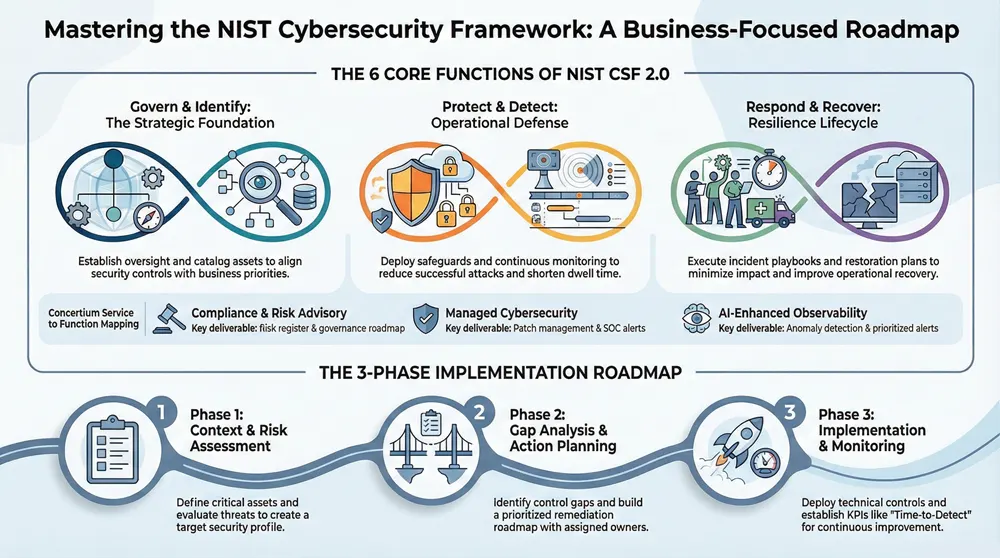
NIST CSF groups security activity into six core functions—Govern, Identify, Protect, Detect, Respond, Recover—that together define what a risk-managed program must accomplish. That structure helps translate technical controls into business outcomes, so leaders can prioritize investments and measure progress. Consistent adoption improves asset visibility, clarifies ownership, and creates a repeatable cycle of improvement. The table below is a quick reference that links each function to common activities and the business outcomes you should expect when they’re implemented effectively.
Quick reference: each NIST CSF function, typical activities, and expected business outcomes.
This function-to-benefit mapping shows how NIST CSF links specific activities to measurable business outcomes. Use it to set targeted actions and metrics that align security work to organizational priorities.
What the six NIST CSF 2.0 functions cover
NIST CSF 2.0 centers on six functions that form a complete, risk-managed cybersecurity lifecycle. Govern embeds leadership, policy, and oversight into decision-making—examples include supply‑chain risk reviews and policy approval. Identify catalogs assets, maps them to business processes, and assesses risks to produce a target profile aligned to business priorities. Protect deploys safeguards like access controls, timely patching, and encryption to harden systems. Detect focuses on telemetry, observability, and anomaly detection to surface malicious activity quickly. Respond defines incident playbooks, communication protocols, and containment steps to limit impact.
Recover covers business continuity, prioritized restoration, and post-incident improvement to restore normal operations and reduce repeat incidents. Together these functions provide a consistent taxonomy teams can use to map controls and measure effectiveness across the organization.
How NIST CSF improves cybersecurity and risk management
Adopting NIST CSF makes security decisions risk‑informed, measurable, and repeatable—strengthening resilience and reducing exposure to regulatory and operational disruption. The framework helps prioritize investments through a target profile tied to business impact, lowering time spent on low‑value activities. It also improves cross‑functional communication by using common terms and outcomes, so leadership can compare posture across units. Finally, NIST CSF aligns with many regulatory and insurance expectations, aiding audit readiness and sometimes improving insurance terms. For example, a mid‑sized company that inventoried assets, prioritized high‑impact controls, and deployed monitoring reduced mean time to detect and demonstrated maturity to auditors. Those results translate into stronger, evidence‑based risk decisions across the business.
Essential steps to implement NIST CSF
Implementing NIST CSF follows a clear, repeatable roadmap: define scope and business context, run a risk assessment to build a target profile, perform a gap analysis, convert gaps into a prioritized remediation plan, implement controls, and establish continuous monitoring and iteration. This sequence clarifies responsibilities and produces measurable outputs so progress can be tracked. The table below maps each step to its core tasks and deliverables to help teams set realistic milestones.

Step-to-output mapping to turn assessment results into action.
Use this mapping to translate assessments into accountable projects and measurable progress toward your target profile. The sections that follow explain how to run the risk assessment and build an actionable remediation program.
Running a risk assessment and defining your target profile
A NIST-aligned risk assessment starts with a complete asset inventory, then evaluates threats, vulnerabilities, and likelihood to quantify impact against business functions. Catalog hardware, software, data flows, and third‑party dependencies, then score threats by likelihood and impact to populate a risk register. The target profile captures desired outcomes per function—for example, detection time goals or acceptable data‑loss thresholds—and ties them to business priorities. Use the risk register and target profile to drive gap analysis and remediation priorities. If you need outside validation, advisory services can help align the target profile to governance and compliance requirements while keeping risk decisions under your control.
Performing gap analysis and building an action plan
Gap analysis converts the target profile and risk findings into prioritized remediation tasks by mapping current controls to desired outcomes and assigning owners, timelines, and risk-based priorities. Start by documenting control areas and current maturity, then compare to the target profile and score gaps by potential business impact. Build an action plan that specifies deliverables, resource needs, milestones, and KPIs—such as time‑to‑detect and percent complete for remediation. Track progress with simple artifacts: a gap matrix, project plan, and dashboard for governance reviews. This creates a measurable roadmap focused on high‑impact improvements.
How Concertium maps services to NIST CSF
Concertium offers services that align directly to NIST functions so you can convert strategy into operational capability while retaining ownership of risk decisions. Our offerings—Compliance & Risk Advisory, Managed Cybersecurity, AI‑Enhanced Observability, and Post‑Breach Services—provide concrete deliverables to accelerate implementation and sustain monitoring. The table below shows how those services map to NIST functions and sample deliverables an external partner can provide without replacing governance responsibilities.
Which Concertium services support which NIST functions — and what they deliver.
This mapping distinguishes advisory and governance support from operational monitoring, detection, and recovery. The next sections unpack how managed and advisory services align with specific NIST categories and measurable outcomes.
How managed services support Protect and Detect
Managed cybersecurity services put Protect and Detect into daily operation: endpoint hardening, patch management, configuration control, continuous monitoring, and managed detection and response. These services collect telemetry, correlate signals, and run playbooks that triage alerts and escalate confirmed incidents. Expected operational outcomes include improved patch cadence, fewer high‑risk misconfigurations, and higher‑fidelity detections that cut false positives. AI‑enhanced observability improves signal‑to‑noise and automates correlation across logs, endpoints, and network telemetry—delivering actionable alerts and prioritized remediation tasks that map back to NIST Detect and Protect goals.
The advisory role in Identify and Govern
Compliance & Risk Advisory helps with Identify and Govern by implementing governance frameworks, conducting risk assessments, writing policies, and developing a target profile that ties security controls to business objectives and audit readiness. Advisory engagements produce artifacts—risk registers, governance charters, policy suites, and compliance mappings—that demonstrate control intent and evidence for auditors. They also support supply‑chain risk evaluations and help leadership set risk appetite and acceptance criteria. Clear governance and documented risk decisions make it easier for technical teams to prioritize work and produce audit‑ready documentation.
Applying NIST CSF in small and medium enterprises
SMBs can adopt NIST CSF by tailoring the framework to limited resources—prioritizing high‑impact controls, using simplified target profiles, and phasing implementation to spread cost and complexity. The core principle is to focus on controls that protect critical business functions and to use managed services where internal capacity is limited. Below is a pragmatic checklist SMBs can use to achieve measurable security improvements within 90 days.
SMB quick‑start checklist for prioritized NIST CSF adoption.
- Inventory critical assets: List the data and systems whose loss would most disrupt the business.
- Prioritize high‑impact controls: Start with multi‑factor authentication, patching, and reliable backups.
- Use managed services for coverage: Outsource 24/7 detection and response where hiring isn’t feasible.
- Create a simple incident plan: Document roles, escalation paths, and communication steps for common incidents.
- Measure a few KPIs: Track time‑to‑detect, time‑to‑contain, and patch compliance to show progress.
This checklist gives SMBs a practical path to reduce risk quickly while building toward fuller NIST alignment and helps guide vendor selection and engagement models for constrained teams.
Key considerations for SMB adoption
SMBs should balance budget, staffing, control selection, and vendor capability when adopting NIST CSF. Focus first on low‑cost, high‑impact controls—access management, endpoint protection, backups, and basic monitoring. Fill staffing gaps with managed detection and response or observability services that deliver 24/7 coverage without heavy hiring. Choose vendors that map services to NIST functions, provide clear SLAs, and report measurable KPIs tied to business outcomes. A 30/60/90‑day plan—inventory, then patching, then monitoring—builds momentum and makes governance conversations concrete.
How Concertium designs SMB solutions
Concertium builds SMB programs with advisory‑led assessments that produce prioritized roadmaps, modular managed service packages that scale coverage, and pragmatic observability options that surface actionable alerts without excess noise. Typical engagements begin with a streamlined assessment producing a target profile and remediation list, followed by phased managed services that operationalize protections and monitoring. This model converts risk into prioritized projects and offers operational choices that fit budgets while accelerating time‑to‑detect through AI‑enhanced observability—balancing protection with governance for steady, measurable improvement.
Continuous monitoring and post‑breach recovery best practices
Continuous monitoring and post‑breach recovery under NIST CSF require a programmatic approach that combines centralized telemetry, AI‑enabled observability, practiced incident response, and a formal recovery process that captures lessons learned. Monitoring should centralize logs, collect endpoint telemetry, and provide network visibility with tuned alerting that emphasizes high‑confidence anomalies. Post‑breach recovery needs containment playbooks, forensic analysis, prioritized data restoration, and a retrospective process that updates controls and governance to prevent recurrence. Below are practical dos and don’ts to help teams build a resilient detect‑respond‑recover capability aligned to NIST.
Practical best practices to sustain monitoring and recovery capabilities.
- Do centralize telemetry: Aggregate logs and metrics from endpoints, network, and cloud into a searchable store.
- Do tune detections: Use use‑case driven tuning and behavioral baselines to reduce false positives.
- Do run tabletop exercises: Rehearse response plans regularly to validate roles and communications.
- Don’t skip post‑incident reviews: Every event should produce action items and control updates.
- Don’t over‑automate without oversight: Monitor automation to avoid unintended actions during incidents.
How AI‑enhanced observability strengthens Detect
AI‑enhanced observability strengthens Detect by using machine learning and behavioral analytics to correlate disparate telemetry, surface high‑confidence anomalies, and reduce mean time to detect through automated enrichment and prioritization. By turning raw logs and metrics into contextualized alerts, AI helps SOC teams focus on incidents that matter and avoid chasing noise. Examples include anomaly detection that highlights unusual lateral movement, automated correlation that links endpoint alerts to suspicious network flows, and prioritized scoring that speeds investigation. Better situational awareness shortens detection windows and enables earlier containment—directly supporting NIST Detect objectives.
Incident response and recovery strategies that follow NIST
Effective incident response and recovery aligned with NIST CSF combine a tested IR plan, clear roles and escalation paths, rapid containment playbooks, and structured recovery procedures that restore operations while preserving forensic evidence. Build playbooks for high‑risk scenarios, prepare stakeholder communication templates, and track KPIs like time‑to‑detect and time‑to‑contain. Recovery should include prioritized system restoration, data validation, and post‑incident reviews that create formal remediation tasks. Regular exercises and after‑action reports ensure lessons learned become control improvements. If you need external support, post‑breach specialists can provide incident managers and technical resources to accelerate recovery and reduce operational impact.
For organizations looking for a partner to accelerate NIST CSF adoption and sustain monitoring and response, Concertium’s integrated service suite combines advisory, managed security, AI‑observability, and post‑breach capabilities mapped to NIST functions while preserving your governance. Our Collective Coverage Suite (3CS) offers a consolidated engagement model for assessment and operationalization—reach out to start an evaluation or discuss next steps.
Frequently Asked Questions
Conclusion
NIST CSF gives organizations a structured, business‑focused way to improve cybersecurity and align controls with priorities. By following a staged implementation—scope, assess, gap, plan, implement, and monitor—you can improve compliance readiness, reduce operational risk, and build a program that measurably improves over time. When you’re ready to move from assessment to action, Concertium’s advisory, managed, AI‑observability, and post‑breach services can accelerate your journey while preserving your governance and decision rights. Start building a resilient, measurable security program today.