AI Overview:
This blog explains GRC—Governance, Risk, and Compliance—as an integrated approach that helps organizations achieve goals, manage threats, and meet regulations. Instead of separate teams working in silos, GRC unifies policies, risk assessments, and compliance activities to reduce costs, eliminate blind spots, and improve decision-making.
The article defines governance as leadership and policy structure, risk management as identifying and controlling threats, and compliance as following laws and standards. It highlights benefits like stronger cybersecurity, fewer duplicated tasks, better transparency, and higher stakeholder trust. It also touches on popular frameworks (OCEG, COSO, NIST, ISO) and the role of automation and GRC platforms in replacing manual, inefficient processes.
What Is Governance, Risk, and Compliance in Today’s Business World?
When you define governance risk and compliance, you’re looking at an integrated approach that helps organizations reliably achieve their objectives while managing uncertainty and acting with integrity. GRC stands for Governance, Risk, and Compliance – three interconnected disciplines that work together to create what experts call “Principled Performance.”
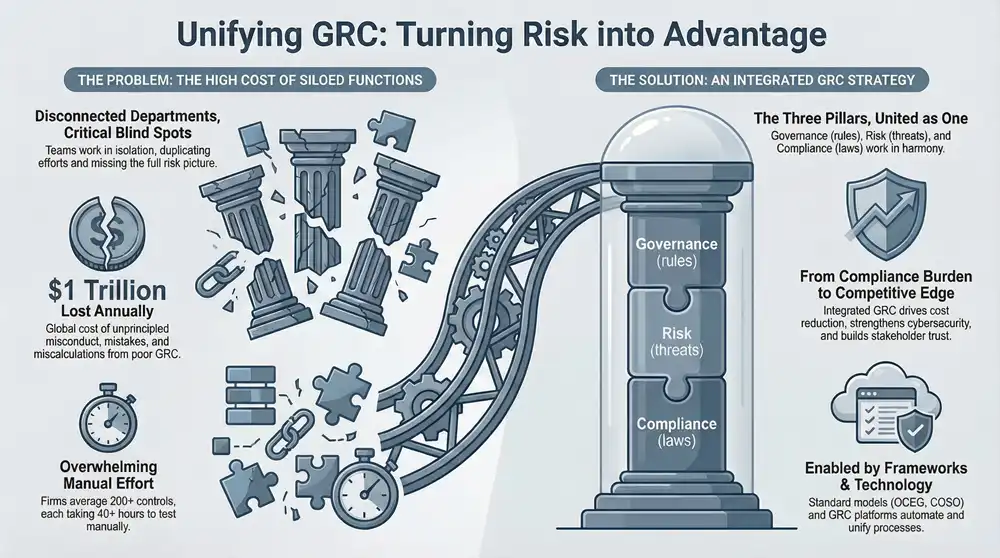
Here’s what each component means:
- Governance: The rules, policies, and processes that guide how your organization is managed and led toward achieving its goals
- Risk Management: The systematic approach to identifying, assessing, and controlling threats that could prevent your organization from reaching its objectives
- Compliance: Adhering to laws, regulations, industry standards, and internal policies to avoid penalties and maintain ethical operations
The power of GRC lies in its integrated nature. Rather than treating these three areas as separate functions, modern organizations are finding that synchronizing governance, risk, and compliance activities leads to better results with less effort.
Why does this matter for your business? Research shows that over $1 trillion is lost annually due to unprincipled misconduct, mistakes, and miscalculations. Organizations typically manage 200+ key internal controls, with each taking 40+ hours to test – often only once per year. This manual, disconnected approach creates blind spots and inefficiencies.
When done right, GRC transforms from a compliance burden into a competitive advantage. It enables data-driven decision-making, reduces operational costs, strengthens cybersecurity posture, and builds stakeholder confidence.
The shift toward integrated GRC isn’t just about avoiding problems – it’s about creating a framework that supports sustainable growth while maintaining ethical standards. As cyber threats increase and regulations multiply, having a mature GRC strategy becomes essential for business continuity and success.
Define governance risk and compliance definitions:
What Does it Mean to Define Governance, Risk, and Compliance (GRC)?
When you define governance risk and compliance, you’re looking at something much more powerful than three separate business functions working in isolation. Think of it as creating a symphony orchestra where every musician plays in harmony, rather than having individual performers scattered across different rooms.
The Open Compliance and Ethics Group (OCEG) – the organization that coined the term GRC back in 2002 – puts it beautifully. They define GRC as “the integrated collection of capabilities that enable an organization to reliably achieve objectives, address uncertainty, and act with integrity.” This concept is known as Principled Performance®, and it’s about so much more than just checking compliance boxes.
Here’s what makes this integrated approach so game-changing: instead of your IT team managing cybersecurity risks in one corner, your legal team handling regulations in another, and your executives making governance decisions without full visibility, everyone works together with synchronized information and shared objectives.
Without this integration, organizations often find themselves trapped in costly silos. Your risk management team might spend weeks assessing a particular threat, while your compliance team unknowingly duplicates that same work from a regulatory perspective. Meanwhile, your governance committee makes strategic decisions without understanding the full risk picture. It’s like trying to solve a jigsaw puzzle when different people are working on separate pieces in different rooms.
The beauty of an integrated GRC approach lies in how it transforms these disconnected activities into a cohesive strategy. When you achieve true strategic alignment, every decision – from daily operations to long-term planning – is informed by a complete understanding of your objectives, the uncertainties you face, and the regulatory landscape you must steer.
This isn’t just theoretical. Organizations with mature, integrated capabilities see dramatic improvements in efficiency, cost reduction, and decision-making quality. They can respond faster to emerging threats, adapt more quickly to regulatory changes, and pursue opportunities with confidence because they understand their risk appetite.
If you’re ready to dive deeper into how this works in practice, our comprehensive guide on What is Governance, Risk, and Compliance (GRC)? provides real-world examples and implementation strategies. For those interested in the framework that supports this integration, the OCEG GRC Capability Model offers a detailed roadmap for building these capabilities.
The Three Pillars of GRC: A Deeper Dive
To truly define governance risk and compliance, imagine three pillars supporting a bridge. Each pillar is strong on its own, but together they create something that can weather any storm. Let’s explore what makes each pillar essential to your organization’s success.
Governance serves as your organization’s North Star – it’s the collection of corporate policies, decision-making processes, and leadership structures that guide how your company operates. Think of it as the invisible hand that ensures everyone is rowing in the same direction. Good governance balances the interests of all stakeholders – from shareholders and employees to customers and the broader community. It creates accountability by establishing clear roles, responsibilities, and reporting structures that make transparency possible.
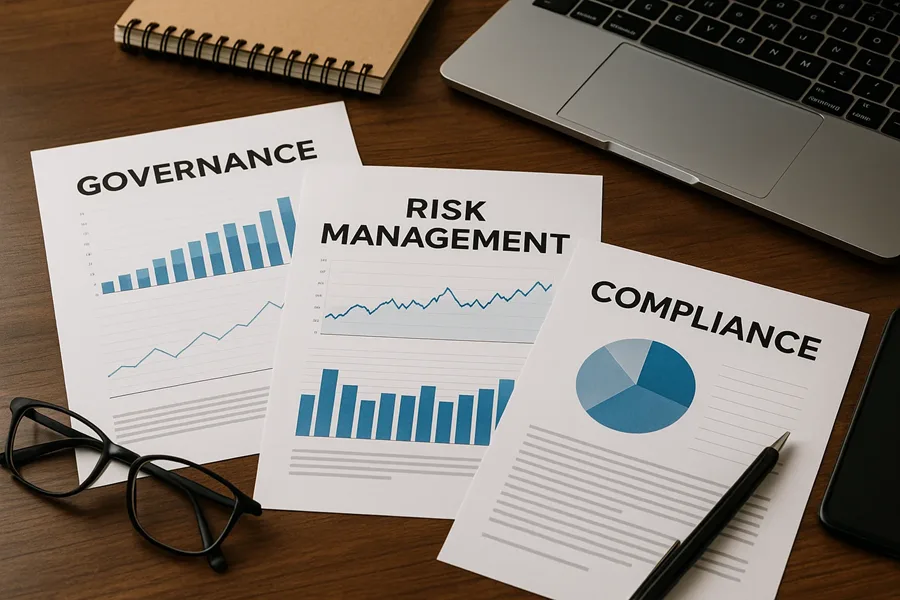
When governance works well, it feels almost effortless. Decisions get made efficiently, ethics guide daily operations, and everyone understands how their work contributes to larger objectives. When it’s lacking, you’ll see confusion, conflicting priorities, and a culture where “that’s not my job” becomes the default response.
Risk Management is where your organization gets proactive about uncertainty. Instead of waiting for problems to knock on your door, effective risk management goes out looking for them – then figures out how to handle them before they become crises. This involves risk identification (what could go wrong?), thorough risk assessment (how likely is it and what would the impact be?), and smart mitigation strategies (how do we prevent, reduce, or transfer these risks?).
At Concertium, we see organizations grapple with risks ranging from cyber attacks and data breaches to supply chain disruptions and regulatory changes. The companies that thrive are those that view risk management not as a defensive necessity, but as a competitive advantage. They’re the ones who can pursue bold opportunities because they understand and have planned for the risks involved. Our Risk Management services help organizations build this proactive mindset.
Compliance is often misunderstood as simply “following the rules,” but it’s actually about building trust and credibility in a complex world. It encompasses regulatory adherence to external requirements like GDPR Compliance in Cybersecurity Services for data protection or healthcare regulations covered in our HIPAA Breach Prevention Best Practices guide. But compliance also means living up to your own internal policies and ethical standards.
The most successful organizations view compliance not as a burden, but as a foundation for sustainable growth. They understand that regulatory requirements often reflect best practices that protect both the organization and its stakeholders. When compliance is integrated with governance and risk management, it becomes a natural part of how business gets done, rather than an afterthought or obstacle.
Why GRC is a Business Imperative
The days when GRC was considered a “back office” function are long gone. In today’s interconnected, regulated, and rapidly changing business environment, define governance risk and compliance has become as essential as having a solid marketing strategy or efficient operations.
The numbers tell a compelling story. Organizations lose over $1 trillion annually due to unprincipled misconduct, mistakes, and miscalculations. That’s not just a statistic – it represents real companies facing bankruptcy, careers destroyed, and communities harmed. Meanwhile, most organizations manage 200+ internal controls, with each requiring 40+ hours to test, often only once per year. Without integration, this creates a perfect storm of inefficiency and blind spots.
But here’s the exciting part: organizations that get GRC right see changeal benefits. They make data-driven decisions because they have reliable, consistent information flowing from integrated systems. They achieve cost reduction by eliminating the duplicated efforts that plague siloed organizations. Their operational efficiency improves because processes are streamlined and everyone works from the same playbook.
Perhaps most importantly in today’s threat landscape, integrated GRC dramatically strengthens cybersecurity posture. When cyber threats are managed as part of a broader risk framework rather than in isolation, organizations can respond more effectively and recover more quickly. Our Cybersecurity Compliance Services: Top 3 Benefits explores how this integration creates a more resilient security posture.
The business world has also become more transparent, and stakeholders – from customers to investors to regulators – expect organizations to demonstrate improved reputation through ethical conduct and responsible management. Companies with mature GRC programs build trust that translates directly into competitive advantage.
What’s driving this imperative? Regulatory pressure continues to intensify across industries, with new requirements emerging regularly. Cyber threats have evolved from nuisance attacks to sophisticated operations that can cripple organizations overnight. Third-party risk has exploded as supply chains become more complex and digital. Globalization means organizations must steer multiple legal and cultural contexts simultaneously.
The organizations that thrive in this environment are those that view GRC not as a compliance exercise, but as a strategic capability that enables confident decision-making and sustainable growth.
How to Build an Effective GRC Strategy
Building an effective GRC strategy isn’t something you can check off your to-do list once and forget about. It’s more like tending a garden – it requires ongoing attention, nurturing, and adaptation as conditions change. When you define governance risk and compliance as an integrated approach, you’re setting the foundation for sustainable business success.

The journey toward effective GRC begins at the top. Executive buy-in isn’t just helpful – it’s absolutely essential. Without leadership commitment, your GRC initiative will struggle to gain the resources, attention, and organizational support it needs to succeed. Think of senior management as the champions who set the tone and demonstrate that GRC isn’t just a compliance exercise, but a strategic business enabler.
One of the most critical elements we focus on at Concertium is establishing a risk-aware culture. This means creating an environment where every employee – from the C-suite to front-line workers – understands their role in managing risks and maintaining compliance. It’s about fostering open communication where people feel comfortable raising concerns without fear of blame or retribution.
As governance expert Tara Oldham notes, effective risk governance considers not just standards and regulations, but also the strategic direction and opportunistic nature of risk. When you embed this mindset into daily operations, risk management becomes second nature rather than an afterthought.
Our experience with Governance, Risk, and Compliance (GRC) Strategies and Compliance and Risk Management has shown us that the most successful organizations treat GRC as a strategic differentiator, not just a necessary burden.
Step-by-Step GRC Implementation
Implementing a robust GRC strategy requires a thoughtful, systematic approach. While every organization’s journey is unique, there’s a proven roadmap that helps ensure success and minimize common pitfalls.
Start by defining clear goals and objectives. Before diving into frameworks or technology, take a step back and ask: What do we want to achieve? Are you looking to reduce compliance costs, improve risk visibility, improve decision-making capabilities, or strengthen your overall security posture? Having specific, measurable objectives gives your GRC program direction and helps you track progress along the way.
Next, assess your current state honestly. This means taking a comprehensive look at your existing governance structures, risk management practices, and compliance processes. Where are the gaps? What’s working well? What’s causing headaches or inefficiencies? A thorough Compliance Risk Assessment often reveals surprising insights about redundancies, blind spots, and opportunities for improvement.
Selecting the right GRC framework comes next. This isn’t about finding the “best” framework in general – it’s about finding the one that fits your organization’s size, industry, regulatory requirements, and risk profile. The framework you choose will serve as your blueprint, so take time to evaluate your options carefully.
Technology implementation can be a game-changer when done right. Modern GRC platforms can automate routine tasks, centralize data from across your organization, and provide real-time visibility into your risk and compliance posture. This shift from manual, spreadsheet-based processes to integrated systems often delivers immediate efficiency gains.
Training and education might seem obvious, but it’s where many organizations stumble. Your GRC strategy is only as strong as the people who execute it daily. Comprehensive training helps employees understand not just what they need to do, but why it matters and how their role contributes to the organization’s success.
Finally, continuous monitoring and improvement keeps your GRC program relevant and effective. The business environment, regulatory landscape, and threat landscape are constantly evolving. Regular reviews, feedback collection, and program adjustments ensure your GRC strategy continues to deliver value over time.
Popular GRC Frameworks and Models
Choosing the right framework is like picking the right foundation for a house – it needs to support everything you’ll build on top of it. Fortunately, several well-established frameworks can provide structure and guidance as you define governance risk and compliance for your organization.
The OCEG GRC Capability Model, often called the “Red Book,” stands out as one of the most comprehensive approaches available. This open-source model integrates risk management, governance, audit, ethics, IT, and compliance into a cohesive whole. It’s built around four interconnected components that create a continuous improvement cycle.
Learn involves understanding your business context, organizational culture, and stakeholder expectations. Align ensures your strategy and daily actions support your objectives and values. Perform focuses on taking the right actions to promote positive outcomes while preventing negative ones. Review creates the feedback loop that keeps everything on track and identifies areas for improvement.
This model provides the foundation for achieving Principled Performance® – the integrated approach that enables organizations to reliably achieve objectives while acting with integrity.
COSO frameworks have been trusted by organizations for decades. The Committee of Sponsoring Organizations offers both Enterprise Risk Management guidance and Internal Control frameworks that help organizations build robust governance structures and risk management processes.
For cybersecurity-focused organizations, NIST frameworks provide invaluable guidance. The NIST Cybersecurity Framework offers a repeatable process for managing cyber risks, while specific processes like the NIST Incident Response Process help organizations prepare for and respond to security incidents effectively.
ISO standards bring international best practices to your GRC program. ISO 31000 provides comprehensive risk management principles, while ISO/IEC 27001 focuses specifically on Information Security Management Systems. These standards are particularly valuable for organizations operating globally or seeking internationally recognized certifications.
Our expertise in Cybersecurity Risk Management Frameworks helps organizations steer these options and select the combination that best fits their unique needs and objectives.
Common GRC Challenges and How to Overcome Them
Even with the best intentions and solid planning, GRC implementation comes with its share of obstacles. The good news is that most challenges are predictable and solvable with the right approach and mindset.
Siloed departments and disconnected data represent perhaps the biggest barrier to effective GRC. When governance, risk, and compliance functions operate independently, you end up with duplicated efforts, inconsistent information, and blind spots that can leave your organization vulnerable. Different teams might be assessing the same risks using different methodologies, or compliance efforts might not align with strategic risk priorities.
The solution lies in breaking down these barriers through integrated platforms and cross-functional collaboration. Modern GRC technology can centralize data and workflows, giving everyone a single source of truth. But technology alone isn’t enough – you need to foster communication and cooperation between departments.
Manual processes and lack of automation create inefficiencies that can make GRC feel like a burden rather than a business enabler. When teams are spending 40+ hours testing each control manually, often just once per year, it’s no wonder that GRC can feel overwhelming and reactive rather than strategic.
Investing in GRC automation tools transforms these time-consuming manual tasks into streamlined, continuous processes. Automated monitoring, reporting, and evidence collection free up your team to focus on analysis, strategy, and improvement rather than data gathering.
The complexity of ever-changing regulations can feel like trying to hit a moving target while blindfolded. New laws emerge, existing regulations get updated, and compliance requirements can vary significantly across different jurisdictions and industries.
Leveraging regulatory intelligence capabilities and expert guidance helps you stay ahead of these changes rather than constantly playing catch-up. Our Risk Compliance Advisory services help organizations steer this complexity with confidence.
Change management resistance is natural – people tend to stick with familiar processes, even when they’re inefficient. The key is clear communication about benefits, involving stakeholders in the planning process, and implementing changes gradually. When people understand how GRC improvements will make their jobs easier and more meaningful, resistance typically transforms into enthusiasm.
By addressing these common challenges proactively, organizations can build GRC programs that truly support business objectives while maintaining the highest standards of integrity and compliance.
The Role of Technology and Tools in GRC
Modern GRC management is virtually impossible without the right technology backbone. While define governance risk and compliance is fundamentally about people making smart decisions, technology acts as the central nervous system that makes everything work seamlessly together.
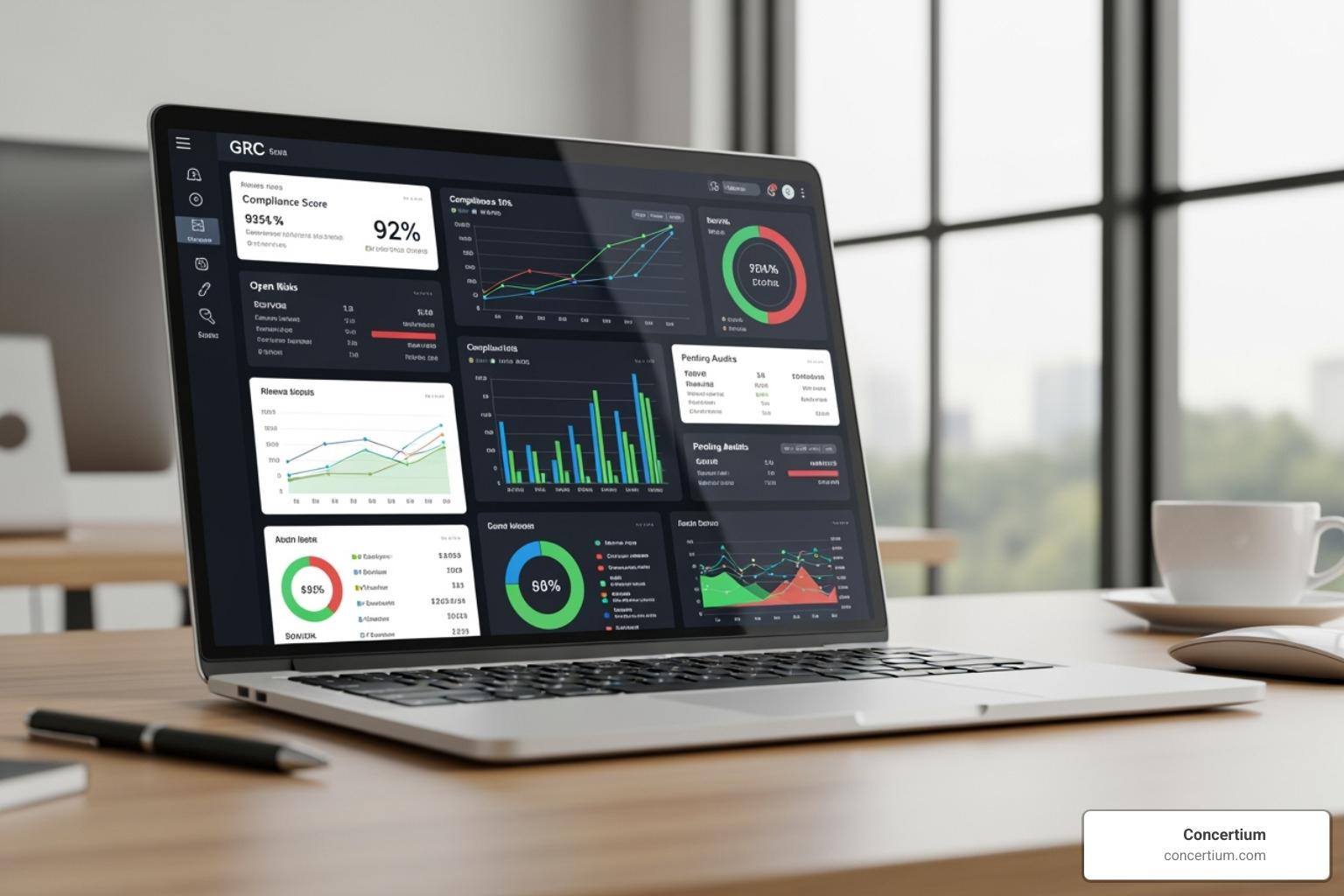
Think about it this way: without proper technology, your GRC team might be drowning in spreadsheets, chasing down email approvals, and manually testing hundreds of controls. That’s not just inefficient—it’s a recipe for human error and missed risks.
The automation benefits alone can transform your entire operation. Instead of spending weeks collecting data for compliance reports, automated systems can pull everything together in real-time. Your team can focus on analyzing trends and making strategic recommendations rather than being buried in administrative tasks.
Centralized data is another game-changer. When all your policies, risk assessments, audit findings, and compliance evidence live in one secure location, everyone works from the same playbook. No more version control nightmares or wondering if you’re looking at the most current policy document.
Real-time monitoring takes things even further. Advanced GRC platforms can watch your systems 24/7, instantly flagging when something doesn’t look right. Maybe a new vulnerability appears, or someone tries to access sensitive data outside normal business hours. Instead of finding issues weeks later during a scheduled review, you can respond immediately.
Improved reporting capabilities mean you can generate comprehensive dashboards for executives or detailed compliance reports for regulators with just a few clicks. This transparency builds confidence with stakeholders and makes audit preparation much less stressful.
At Concertium, our GRC Automation Tools are designed to handle these complex workflows seamlessly. We’ve seen how the right technology can transform organizations from reactive to proactive, especially when combined with our Vulnerability Risk Management expertise.
How GRC Software Helps Define Governance, Risk, and Compliance
GRC software isn’t just a fancy database—it’s an integrated ecosystem that brings structure and intelligence to how you manage organizational performance. When you define governance risk and compliance through software, you’re creating a unified approach that touches every aspect of your business operations.
Policy management becomes incredibly streamlined with the right platform. Instead of hunting through network drives or file cabinets for the latest version of your data handling policy, everything lives in one searchable location. The software tracks who’s acknowledged each policy, sends automatic reminders for reviews, and can even map policies to specific regulatory requirements. This means when regulations change, you immediately know which internal policies might need updating.
Risk analytics capabilities transform how you understand and respond to threats. Modern platforms don’t just store risk information—they analyze it. You might find that certain types of incidents cluster around specific times of year, or that particular departments consistently struggle with the same compliance issues. This insight lets you be proactive rather than reactive.
Audit management features turn what used to be a stressful scramble into a smooth, organized process. The software tracks all your evidence, manages audit schedules, and can even assign remediation tasks with automatic follow-ups. When auditors arrive, everything they need is already organized and accessible.
Workflow automation ensures nothing falls through the cracks. When a new risk is identified, the system automatically routes it to the right person for assessment, then tracks it through evaluation, mitigation planning, and ongoing monitoring. No more wondering if someone forgot to follow up on that critical security issue.
The integration of AI in GRC is particularly exciting. These systems can now predict potential compliance risks by analyzing patterns in your data, automatically compare new regulatory requirements against your existing controls, and even suggest optimal remediation strategies based on what’s worked for similar organizations.
For organizations looking to implement these capabilities at scale, our Enterprise Governance, Risk, and Compliance solutions provide the comprehensive approach needed to manage complex, multi-location operations effectively.
On-Premises vs. Cloud-Based GRC Solutions
Choosing between on-premises and cloud-based GRC solutions is one of those decisions that will shape how your organization manages risk and compliance for years to come. Both approaches have their place, and the right choice depends on your specific needs, resources, and comfort level with different deployment models.
Cost considerations often drive the initial conversation. On-premises solutions typically require significant upfront investment—you’re buying servers, software licenses, and often expensive implementation services. Cloud-based solutions usually follow a subscription model that spreads costs over time, making them more accessible for organizations that prefer predictable monthly expenses over large capital expenditures.
Scalability is where cloud solutions really shine. Need to add fifty new users next month because of an acquisition? With cloud-based GRC, that’s usually just a configuration change. On-premises systems might require additional hardware, software licenses, and significant IT work to accommodate growth.
Security perspectives vary depending on your organization’s philosophy. Some companies feel more secure keeping everything behind their own firewalls, where they control every aspect of data protection. Others prefer leveraging the vendor-managed security that comes with reputable cloud providers, who often have security capabilities that individual organizations couldn’t afford to implement themselves.
Maintenance requirements tell a different story for each model. On-premises solutions put the burden of updates, patches, and system maintenance squarely on your IT team. Cloud solutions handle all of that behind the scenes, but you’re dependent on your vendor’s schedule and priorities.
Accessibility becomes crucial in today’s distributed work environment. Cloud-based solutions naturally support remote access, making it easy for team members to manage GRC activities from anywhere. On-premises solutions can be configured for remote access, but it often requires additional infrastructure and security considerations.
The SaaS model has become increasingly popular because it combines the benefits of professional-grade software with the flexibility of cloud deployment. You get enterprise-level capabilities without the enterprise-level infrastructure requirements, and updates happen automatically without disrupting your daily operations.
Most organizations today lean toward cloud-based solutions for their GRC needs, especially when working with experienced providers who understand the unique security and compliance requirements that come with managing sensitive risk and compliance data.