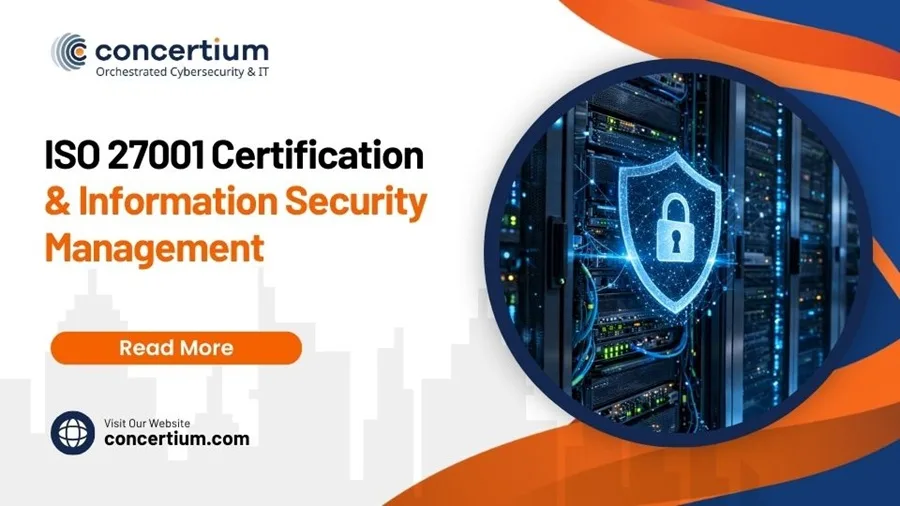

ISO 27001 is the international standard for creating, operating, maintaining, and continually improving an Information Security Management System (ISMS). This guide walks through how an ISMS works — using a risk-driven PDCA (Plan‑Do‑Check‑Act) approach — and why ISO 27001 certification matters for compliance, data protection, and stakeholder trust. Many organisations face regulatory demands, supply‑chain requirements, and rising cyber risk that call for a repeatable, auditable security program; ISO 27001 gives you that structure and a route to third‑party validation.
Read on to learn what ISO 27001 covers, how it enforces the CIA principles, the business benefits of certification, a step‑by‑step implementation roadmap, the certification lifecycle, how ISO 27001 compares with SOC 2, and practical ways a specialist partner like Concertium can help. We also use common search terms—ISO 27001, ISMS certification, ISO 27001 audit, ISO 27001 implementation—to keep this guidance aligned with real‑world needs.
What is ISO 27001 Certification and Why is it Essential?

ISO 27001 certification proves an organisation has implemented an ISMS that systematically manages information risk across policy, process, people, and technology. The standard asks organisations to assess risks, choose and apply appropriate controls (many drawn from Annex A), and use the PDCA cycle to monitor and improve the ISMS continuously. That discipline lowers the chance of breaches and helps meet legal and contractual obligations. For business leaders, ISO 27001 is an auditable framework that demonstrates due diligence, enables consistent security governance at scale, and helps teams prioritise effort so security becomes part of everyday operations.
Defining ISO 27001 and the Information Security Management System Framework
ISO 27001 defines an ISMS as the combination of policies, procedures, people, and technology that protect information confidentiality, integrity, and availability. Key ISMS components include a defined scope, security objectives, risk assessment and treatment, a Statement of Applicability (SoA), documented procedures, and continuous improvement through management review and internal audit. ISO 27002 and Annex A offer control guidance and example objectives that organisations map to identified risks. That mapping — assets → risks → controls — produces the audit evidence auditors expect and focuses remediation where it matters most.
Core Principles: Confidentiality, Integrity, and Availability Explained
The CIA triad — confidentiality, integrity, availability — is the risk framework ISO 27001 operationalises through controls and processes. Confidentiality limits access to authorised users via access controls, encryption and data classification. Integrity keeps information accurate and tamper‑free through versioning, integrity checks and change controls. Availability ensures authorised users can access data when needed through redundancy, backups and incident response. Translating these principles across people, processes and technology produces practical controls like user access management, secure configurations, logging and monitoring, and disaster recovery plans — all tied to business outcomes such as lower incident impact, contractual compliance and operational resilience.
What Are the Key Benefits of ISO 27001 Certification for Businesses?
ISO 27001 delivers concrete business benefits across risk reduction, compliance, and market positioning. Below are the primary advantages and how they translate into operational outcomes.
- Risk reduction: An ISMS identifies and treats risks proactively, lowering the frequency and impact of security incidents.
- Regulatory alignment: ISO 27001 maps to data protection laws and sector rules, making compliance reporting more straightforward.
- Customer trust: Certification provides independent validation of security controls, increasing stakeholder confidence.
- Competitive advantage: Certified organisations often win procurement processes and stand out in RFPs.
- Operational improvement: ISMS discipline produces documented processes, clearer responsibilities, and sustained continuous improvement.
These benefits help leaders make strategic choices about security investment and vendor selection. The table below links core benefits to measurable outcomes so teams can prioritise and measure impact.
Enhancing Data Protection and Regulatory Compliance
ISO 27001 strengthens data protection by forcing a risk treatment process that maps controls to specific legal and regulatory obligations, including privacy rules. Controls such as access management, encryption, secure development and logging deliver direct evidence useful for GDPR‑style compliance and industry requirements. Documentation — the risk register, SoA and policies — supports audit responses. For organisations under regulatory scrutiny, ISO 27001 offers a verifiable governance model that reduces the likelihood of fines and supports contractual commitments. Typical deliverables include privacy risk assessments and packaged control evidence that speed up regulatory reporting.
Building Trust and Gaining Competitive Advantage
Certification signals to customers and partners that your organisation manages information security methodically and transparently, which often shortens procurement cycles and eases vendor risk assessments. In competitive bids, ISO 27001 can be a deciding factor that reduces due diligence time and speeds contract wins. From a reputation perspective, third‑party certification lowers perceived vendor risk and supports security claims with accredited proof. That’s why many organisations treat ISO 27001 as both a risk control and a commercial enabler.
If you want external support to realise these benefits, Concertium offers Compliance & Risk Advisory services that align certification outcomes with business goals and accelerate time‑to‑certification through practical gap analysis and prioritised remediation.
How to Implement ISO 27001: Step-by-Step Guide
ISO 27001 implementation follows a clear sequence from scoping to certification readiness, focused on risk assessment and continual improvement. The steps below form a practical roadmap you can adapt to your organisation’s size and sector, with responsibilities and typical deliverables indicated.
- Scope and context: Define ISMS boundaries, stakeholders and business objectives.
- Gap analysis and risk assessment: Inventory assets, map threats and vulnerabilities, and prioritise risks.
- Risk treatment and controls: Select Annex A controls, document an SoA, and implement technical and procedural measures.
- Documentation and training: Create required policies and run awareness and role‑based training.
- Internal audit and management review: Perform internal audits, remediate findings, and hold management review before external audit readiness.
These steps set a predictable implementation sequence and help coordinate cross‑functional teams. The timeline table below gives a condensed, scannable view of phases, deliverables and typical timeframes to aid planning and resourcing.
Conducting Risk Assessment and Gap Analysis
A solid risk assessment starts with asset identification, threat and vulnerability mapping, and likelihood/impact scoring to build a prioritised risk register. Use a simple risk matrix to classify risks, then choose treatments: accept, transfer, mitigate or avoid, and record chosen actions in the SoA. Gap analysis benchmarks current controls and processes against ISO 27001 clauses and Annex A, producing a remediation backlog and resource estimate. Core deliverables from this phase — the asset register, risk register and gap report — feed control selection and implementation planning.
Developing Policies, Controls, and Preparing for Certification Audits
Policy work should produce a concise ISMS scope statement, an information security policy, risk management procedures and supporting documents that show controls operate consistently. Controls include technical measures (access control, logging, encryption) and organisational measures (awareness training, supplier assessments), with each control linked to audit evidence. Internal audits simulate certification by testing controls, logging nonconformities and verifying corrective actions; management review then confirms readiness. Preparing logs, change records, training records and the SoA ahead of the external auditor reduces friction and shortens certification timelines.
Many organisations engage specialist advisors for remediation and program management at this stage. Concertium’s Compliance & Risk Advisory and managed services can deliver gap analysis, policy development and hands‑on implementation support while keeping internal ownership clear.
What Does the ISO 27001 Certification Process Involve?
The ISO 27001 certification lifecycle starts with internal preparation and moves through external audits, surveillance and periodic recertification. Internally you’ll run audits, fix nonconformities and document management review; externally, an accredited certification body performs a stage 1 documentation review and a stage 2 assessment of evidence and implementation. Surveillance audits and recertification cycles keep the ISMS effective as risks and business needs evolve. Knowing auditor expectations and typical timelines helps you allocate resources and avoid common assessment pitfalls.

Understanding Internal and External Audits
Internal audits check that implemented controls meet ISO 27001 requirements and are actually followed; auditors look for objective evidence such as logs, meeting minutes and control operation records. External certification audits start with stage 1 documentation and scope checks, then proceed to stage 2 — on‑site or remote — to verify implementation and effectiveness against clauses and the SoA. Common nonconformities include missing documentation, weak access controls or insufficient monitoring; successful certification depends on remediation plans and evidence of corrective action. Mock audits and audit‑readiness exercises are valuable to surface gaps and rehearse evidence presentation.
Checklist intro: Use this checklist to prepare evidence and anticipate auditor requests.
- Define the scope and provide the ISMS scope statement as evidence.
- Present the risk register and SoA with mapped controls.
- Supply logs, training records, change management records and incident reports.
Focusing on these high‑yield evidence items streamlines stage 1 and stage 2 reviews. Concertium can help with mock audits, evidence packaging and guidance on auditor expectations to raise the odds of a smooth external assessment.
Surveillance, Recertification, and Maintaining Compliance
After certification, organisations typically undergo surveillance audits annually to show the ISMS remains effective, with full recertification every three years per the certification body. Ongoing compliance requires continuous monitoring against KPIs — incident counts, time‑to‑detect, time‑to‑contain, internal audit results and management review minutes — to demonstrate continual improvement. Processes should capture lessons learned from incidents and audits to update risk assessments and controls. A governance rhythm of quarterly or semi‑annual reviews, plus continuous monitoring, keeps the ISMS aligned with business change and the threat landscape.
How Does ISO 27001 Compare to Other Standards Like SOC 2?
ISO 27001 and SOC 2 both address information security but differ in focus and typical use cases. ISO 27001 is an international, certifiable standard centred on a risk‑based ISMS, while SOC 2 is an attestation report addressing trust service criteria often requested by North American customers. ISO 27001 emphasises a management system and continual improvement; SOC 2 focuses on control outcomes mapped to principles such as security, availability, processing integrity, confidentiality and privacy. Your choice depends on customer needs, geography and procurement requirements — many organisations pursue both to cover diverse stakeholder expectations.
Intro to comparison table: The table below summarises ISO 27001 and SOC 2 across focus and strengths to help decision‑making.
Key Differences and Similarities Between ISO 27001 and SOC 2
ISO 27001 uses a management‑system model (PDCA), requiring documented risk assessment, an SoA and continual improvement. SOC 2 is an auditor’s attestation of control effectiveness over specified trust principles. Both require evidence of controls and their operation, but ISO 27001 results in certification from an accredited body while SOC 2 provides an auditor’s report describing control effectiveness over a period. The frameworks complement one another: ISO 27001 builds the governance backbone, and SOC 2 supplies customer‑facing assurance. Cross‑mapping controls reduces duplication and streamlines evidence collection.
When to Choose ISO 27001 or SOC 2 for Your Organization
Decide based on markets, customer expectations and regulatory drivers. Choose ISO 27001 when international certification and a formal ISMS are strategic priorities. Choose SOC 2 when U.S. customers require attestation reports from service providers. Organisations with global footprints or complex regulations often prioritise ISO 27001, while many cloud and SaaS vendors pursue SOC 2 to satisfy North American buyers. Pursuing both is common: ISO 27001 implementation often provides the controls and evidence you can reuse for SOC 2.
How Can Concertium Support Your ISO 27001 Certification Journey?
Concertium provides advisory and managed cybersecurity services aligned to ISO 27001 needs, combining gap analysis, risk advisory, managed detection and observability to support certification and ongoing ISMS operations. Our offerings include Compliance & Risk Advisory for gap reports and policy work, AI‑enhanced observability to supply monitoring evidence, managed security services for continuous control operation, and post‑breach response and forensics. These capabilities map to the main certification phases — assessment, controls implementation, audit readiness and sustained operations — so you can reach certification and maintain the evidence trail over time. For teams seeking hands‑on help, Concertium offers advisory and managed options that address both technical and governance requirements.
Compliance and Risk Advisory Services for Gap Analysis and Implementation
Concertium’s Compliance & Risk Advisory focuses on practical deliverables: gap analysis reports, prioritised remediation roadmaps, updated policies and a draft Statement of Applicability to accelerate audit readiness. Deliverables are scoped to your organisation and include risk register development, Annex A control mapping and an implementation plan that balances effort against business priorities. Engaging advisory services minimises disruption by bringing practitioners who translate ISO 27001 clauses into operational tasks and evidence requirements. This targeted support helps organisations reach certification‑ready status more predictably and with business‑aligned outcomes.
Managed Cybersecurity Services for Ongoing ISMS Support
Concertium’s managed cybersecurity services sustain ISMS controls through continuous monitoring, incident response and AI‑enhanced observability that produce audit‑ready evidence and management review inputs. Mapping managed capabilities to control families — access control, logging and monitoring, incident management — ensures technical and procedural controls run reliably and generate the artifact trail auditors expect. These services reduce the operational load on internal teams while improving detection, response and resilience metrics that feed ISMS KPIs. Paired with advisory support, managed services provide an end‑to‑end path from certification to ongoing compliance and optimisation.
Frequently Asked Questions
What are the costs associated with obtaining ISO 27001 certification?
Costs vary by organisation size, complexity and ISMS scope. Typical expenses include consultancy and training, internal resource allocation, and certification‑body audit fees, plus any investments in controls and technology. As a broad guideline, small‑to‑medium organisations might spend roughly $10,000–$50,000, while larger organisations can exceed $100,000 depending on scope and remediation needs.
How long does the ISO 27001 certification process take?
Timelines depend on readiness and organisational complexity. Typically the full process takes three to twelve months, covering gap analysis, risk assessment, control implementation, internal audits and preparation for external audit. Organisations with existing security practices and strong internal ownership often move faster; those starting from scratch will need more time to build and document the ISMS.
What are the common challenges faced during ISO 27001 implementation?
Common challenges include resistance to change, limited management support, and constrained resources. Accurately assessing risks and selecting appropriate controls can be complex, especially for larger organisations, and documentation demands can be significant. To mitigate these risks, engage stakeholders early, provide role‑based training, and consider specialist consultants to guide implementation and evidence collection.
How often do organizations need to undergo ISO 27001 audits?
After certification, organisations usually have annual surveillance audits to demonstrate ongoing compliance, with full recertification every three years. Maintaining continuous monitoring, internal audits and management reviews helps ensure you remain prepared for these checkpoints.
Can ISO 27001 certification help with GDPR compliance?
Yes. ISO 27001’s emphasis on risk management and technical and organisational measures aligns well with GDPR requirements. Implementing an ISMS helps demonstrate you’ve assessed and managed data security risks, strengthening your overall data protection posture and reducing the likelihood of regulatory penalties.
What role does employee training play in ISO 27001 compliance?
Employee training is essential — it ensures staff know their security responsibilities and helps build a culture of awareness. Regular training should cover policies, incident response, data handling and the core CIA principles. Effective training reduces human error, which remains a common cause of security incidents.
Conclusion
ISO 27001 gives organisations a practical, auditable way to manage information security — reducing risk, supporting compliance and strengthening customer trust. A well‑implemented ISMS delivers measurable operational improvements and commercial benefits. Working with experienced providers like Concertium can streamline your certification journey and help you sustain compliance over time. If you’re ready to protect your data and reputation, explore our tailored advisory and managed service options to get started.